We've got a couple of concerts coming up this fall... the first one is next week! I've been busy preparing introductions for each of the songs with my Japanese teacher, as a first "assignment" in a course dedicated to sermons and other public speaking. It's next Monday, September 17, 1:00 p.m. at Kita-Hiroshima church, as part of our church's bazaar. We will be raising money for ongoing relief work. Keith and I will perform together, and present stories and pictures from our time doing relief work in Miyako and Ishinomaki.
The second concert is Sunday, October 14 at 7:15 p.m. at Kitara concert hall, small hall. (If you want tickets, they are 2000 yen, and you can get them from us.) We'll be performing German baroque works (mostly sacred) on period instruments. I will be playing viola da gamba, and Keith, my dad, and I will be in the chorus. (I offered to sing and play at the same time, but it looks like I'll be doing one at a time... ;)
We would appreciate your prayers as we prepare--not only for good practices and performances, but also for the friendships we are forming along the way!
Sunday, September 09, 2012
Saturday, September 08, 2012
Cultural Education Journal: Another Umeboshi Post!
Well, they're done. It was a lot of work, but it was worth it! Not trying to toot my own horn or anything, but even though I'm supposed to let them age for another 4 months or so, they're delicious, so I can't help but eat some right away... and it's been despicably hot here. Umeboshi are the only thing that make me feel better some days. :)
Here's some photos of the process from start to finish.
Actually, the beginning of the process was talking to my teachers at school and to the ladies at church. They provided me with all kinds of recipes and information. For some women, making umeboshi is a yearly ritual, something they learned from their mothers and hope to pass on to their daughters or daughters-in-law. It's become rather rare for women of my generation to go to all this trouble, when you can buy umeboshi in the store. But there's just something wonderful about homemade umeboshi... or any kind of homemade pickle.
I bought about 5 kg of ume plums. They smelled heavenly, similar to apricots. I had to wait about a week until they ripened fully. Since the ume have to be absolutely perfect--no blemishes whatsoever, or they might mold--I used the less than perfect ones to make ume syrup, which makes a delicious soda when added to sparkling water. (And then we liked the ume syrup so much that we started keeping watch for sale-ume at the store and made a second batch... :)
The ripened plums were sprinkled with salt (lots and lots of salt!) and arranged in a giant pickling crock, and then I put about 7 kg of weights on top.
The purpose of the weights is to get the plums to release their juices. Of course the salt is also crucial to this process too. I think with 13% salt and more than 2x the weight of the plums set on top, it only took about 36 hours for the plum juices (ume-su) to rise above the top of the plums. Then I reduced to a single 2 kg weight.
The next step is to wait and wait. I went on vacation and came back... and then waited some more. I think it was only supposed to be about 2 weeks, but I couldn't find large quantities of red shiso or shin-shouga (young ginger). Eventually I did. (And I discovered a great grocery store in the process--Hokuren Shop sells lots of local stuff, including gorgeous locally grown beets that you usually can't find in Japan! But they will also special order stuff at no extra charge. Yay for great veggies and great customer service!)
The next step was to salt the red shiso and squeeze out the excess juices, then mix with some of the ume-su. Finally, the shiso and ginger are layered back into the pickling crock on top of the plums to add flavor and color.
And then we wait a bit longer... for some good weather, since the ume and shiso are sun-dried to give them a nice texture and improve the flavor. Finally we had nice weather... and then it rained and rained. So I put them out for one day, but then they went back in the crock in the ume-su again for another week or so while I waited for the weather to clear up.
Finally, we had a few sunny days in the forecast! (I'm laughing to remember how I hoped for hot weather, given the last several weeks... thankful that it's raining today!!) The ume dried in the sun for about 4 more days. Usually it would have been 3 total, but because our balcony is quite narrow, they only got about 3-4 hours of direct sunlight/day.
Finally I gathered them up and put them in a pickle jar to wait until New Year's. The flavor will continue to improve for the next 5 years or so, according to my Japanese friends.
Only I couldn't wait. I've been sampling them with some regularity...
Ah, delicious umeboshi!
If you're interested in knowing more about the process in more detail (in English), try this site. My process was slightly different--higher salt content (13%), heavier weights, shiso added later in the process, addition of shin-shouga, and longer drying time.
Here's some photos of the process from start to finish.
Actually, the beginning of the process was talking to my teachers at school and to the ladies at church. They provided me with all kinds of recipes and information. For some women, making umeboshi is a yearly ritual, something they learned from their mothers and hope to pass on to their daughters or daughters-in-law. It's become rather rare for women of my generation to go to all this trouble, when you can buy umeboshi in the store. But there's just something wonderful about homemade umeboshi... or any kind of homemade pickle.
I bought about 5 kg of ume plums. They smelled heavenly, similar to apricots. I had to wait about a week until they ripened fully. Since the ume have to be absolutely perfect--no blemishes whatsoever, or they might mold--I used the less than perfect ones to make ume syrup, which makes a delicious soda when added to sparkling water. (And then we liked the ume syrup so much that we started keeping watch for sale-ume at the store and made a second batch... :)
| Ripening ume plums |
| Ume syrup in progress |
The purpose of the weights is to get the plums to release their juices. Of course the salt is also crucial to this process too. I think with 13% salt and more than 2x the weight of the plums set on top, it only took about 36 hours for the plum juices (ume-su) to rise above the top of the plums. Then I reduced to a single 2 kg weight.
The next step is to wait and wait. I went on vacation and came back... and then waited some more. I think it was only supposed to be about 2 weeks, but I couldn't find large quantities of red shiso or shin-shouga (young ginger). Eventually I did. (And I discovered a great grocery store in the process--Hokuren Shop sells lots of local stuff, including gorgeous locally grown beets that you usually can't find in Japan! But they will also special order stuff at no extra charge. Yay for great veggies and great customer service!)
The next step was to salt the red shiso and squeeze out the excess juices, then mix with some of the ume-su. Finally, the shiso and ginger are layered back into the pickling crock on top of the plums to add flavor and color.
And then we wait a bit longer... for some good weather, since the ume and shiso are sun-dried to give them a nice texture and improve the flavor. Finally we had nice weather... and then it rained and rained. So I put them out for one day, but then they went back in the crock in the ume-su again for another week or so while I waited for the weather to clear up.
Finally, we had a few sunny days in the forecast! (I'm laughing to remember how I hoped for hot weather, given the last several weeks... thankful that it's raining today!!) The ume dried in the sun for about 4 more days. Usually it would have been 3 total, but because our balcony is quite narrow, they only got about 3-4 hours of direct sunlight/day.
| Shiso is in the foreground; the ume are covered to prevent bug-attack. |
| The before picture: the ume are still quite plump and light colored. |
| The after picture: shriveled and sparkly with salt crystals. |
Only I couldn't wait. I've been sampling them with some regularity...
Ah, delicious umeboshi!
If you're interested in knowing more about the process in more detail (in English), try this site. My process was slightly different--higher salt content (13%), heavier weights, shiso added later in the process, addition of shin-shouga, and longer drying time.
Sunday, August 12, 2012
待つこと
This is a short devotion I (Keith) prepared for Japanese class about waiting.
私たちはみんな毎日何回も「待つ」ということをしなければなりませんね。好きな番組が始まるまでとか電車の出発を待つとかいう場合が多いですね。でも、一番大変なのは長い間待たなければならないことだと思います。すでに1年日本に住んでいますが、実は2年前には、いつ日本に行けるかわからないやきもきした状態でした。そのつらい1年間毎日毎日日本に行きたいと思っていましたが、待たなければなりませんでした。そんな中、ある日聖書のモーセの話を読んで考えました(出エジプト2章)。モーセは最初に自分からイスラエルのリーダーを志しましたが、すぐにはなることができませんでした。なぜなら、モーセのやり方と神様のやり方は違うので、まずモーセの心の準備が必要でした。
モーセは40年間待ちました。そのことを読んだら、「えー、そんなに長く待たなくちゃならないの?私にはできない」と思いました。でも、モーセのように私も心の準備が必要でした。モーセの40年間のように私の1年間が過ぎました。その間、私のすべて、住まいとか仕事とか特にお金のこととかを神様に頼るようになりました。そして神様は私の信頼に本当に答えてくださいました。今は日本語学校の卒業を待っていますが、実は待っているのではなく、神様と共にいるので、待つことは準備することになります。聖書にこのような助言が書いてあります。「機会を十分に生かして用いなさい(エペソ5:16)」。つまり、人の一生は毎分、大切で意味があるということです。
Saturday, July 28, 2012
July Newsletter
Seasons
Keith and Celia Olson
Newsletter #18
July 18, 2012
Dear Friends and Family,
We’ve been enjoying a relatively cool summer in Sapporo, which is particularly a blessing considering our apartment averages 5-10 degrees warmer than outside. This July marks our first year in Japan as full time missionaries, and we continue to feel overwhelmed by thankfulness for everyone who has helped us to get here and who continues to support us month by month. We wish we could send each of you an individual message accompanied with a hug, but time and distance prevent this, so we must be content with methods such as Facebook. Please know that we value you and any messages, pictures, prayers, or Skittles that you send our way. This month also marks our seventh wedding anniversary, which we celebrated in Yamagata prefecture, where we got rained on, sun-burnt, onsen-boiled, and stuffed with tons of Japanese delicacies; in short, it was a very successful endeavor. We were also able to spend time with the Takahashi family, our friends from Seattle who were visiting their home church.
| Celebrated seventh anniversary at a traditional Japanese hotel with very, very good food. |
| with our Seattle/Yamagata friends |
Aside from that, our concerts (Celia’s viola da gamba concert and Keith’s choir concert) at the end of May went well, and we continue with rehearsals for our upcoming concerts in the fall. We are always surprised to see how much Japanese people loosen up at the after concert parties.
| Celia is much more easily seen at her concerts than Keith is at his. |
We have also successfully booked and passed our written and driving tests, and we have both received our Japanese driver’s licenses after a few sleepless nights and over 20 hours of waiting, filling out forms, and more waiting. And as always we have our language classes...
***
The Long Haul
I (Celia) confess that as we were thinking about this newsletter, I was not very excited to write it. The way we write these takes a significant amount of time--it’s important to us to go beyond a blow-by-blow of what’s been happening in our lives to reflect on what we are learning and experiencing. However, the subjects of our “reflection pieces” are often our struggles and feelings of weakness and inadequacy. I just couldn’t face another one of those this time around. But those sorts of essays will certainly continue, probably for the next 30 years or so. I’m praying they will be punctuated by success stories occasionally.
We’ve been in Japan almost a year now; a year ago at this time we were midway through orientation course in Singapore. Also, at the end of the month, it will have been 3 years since we arrived in Japan for the first time. As I look back, I’m still surprised at how God worked in my life to gently nudge me in the direction of Japan--had you told me even 5 years ago that I would become a missionary, I would have laughed. But here I am in Japan, and I’m incredibly thankful for that.
I read the following during my quiet time yesterday: “Be assured that from the first day we heard of you, we haven't stopped praying for you, asking God to give you wise minds and spirits attuned to his will, and so acquire a thorough understanding of the ways in which God works. We pray that you'll live well for the Master, making him proud of you as you work hard in his orchard. As you learn more and more how God works, you will learn how to do your work. We pray that you'll have the strength to stick it out over the long haul—not the grim strength of gritting your teeth but the glory-strength God gives. It is strength that endures the unendurable and spills over into joy, thanking the Father who makes us strong enough to take part in everything bright and beautiful that he has for us” (Colossians 1:9-12, The Message).
It’s not enough that we have followed God’s leading and obeyed by coming to Japan. Every day I’m pondering what it means for God to be Lord of my life. Recently what that means for me is to be still before God and listen, to see what he is doing. That’s how I will get the “strength to stick it out over the long haul.”
It seems that the 1 year we’ve been here has gone by incredibly fast... and yet incredibly slowly, as language school drags on and on. We struggle with wanting to be finished with study (by the time we finish, I will have studied for 12 years of formal education beyond high school) and at the same time, balancing that desire with the knowledge that this is our best opportunity to learn Japanese, even if it’s rather like drinking from a fire hose.
This year our language skill have improved in a big way. Last Sunday we heard a sermon from a pastor who had been advising our church (Lighthouse) when we were short-termers. Last time we heard him preach, we didn’t understand him at all, but this time, we understood most of it! We’ve also had numerous opportunities to develop friendships with Japanese and learn about Japanese culture. And we even got Japanese driver’s licenses!
This year we have seen God at work in our church, in our friends, and in us. There have been many challenges, but the ways God has united us as a couple in the midst of these challenges reminds us that he will continue to provide for and protect us for the long haul. I praise God we are able to be in Japan and participate in God’s work here.
***Prayer Points
- We thank God for our completed first year and pray for many more to come.
- Our concerts at the end of May went well. Pray for our preparation for our church mini-concert (Celia on cello and viola da gamba and Keith on piano) on September 17, and for a concert on October 14 where Celia’s father, Celia, and Keith will join the Baroque Collegium in singing a number of sacred German baroque pieces.
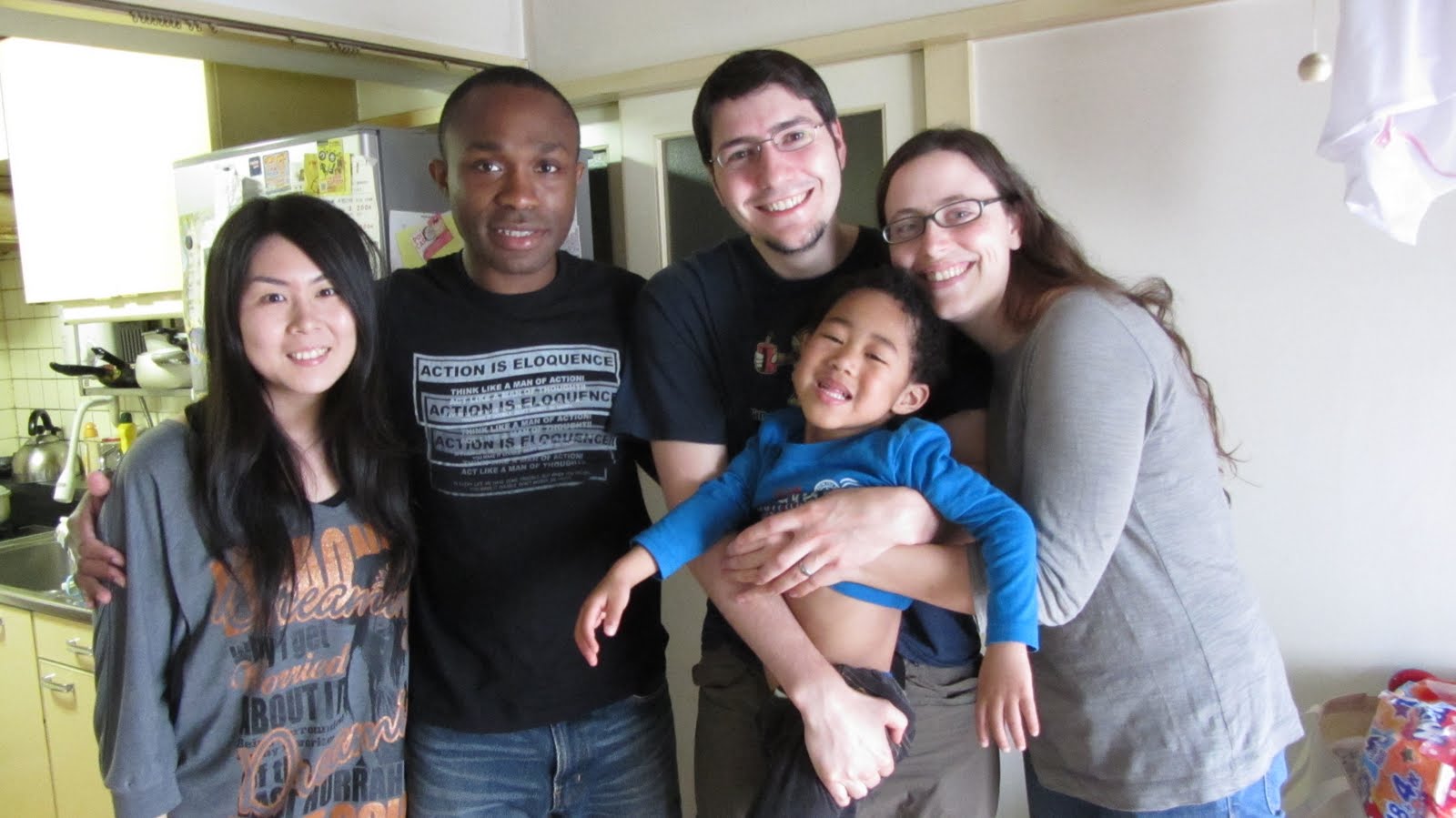
- We give thanks for our dear friend Mikiko and her son, Yugo, who will be moving away to Ghana to be with her husband, Curtis, and his family for a time. It has been very encouraging to see Mikiko’s faith grow over the years, and we will miss her and Yugo a lot..
| We will miss these guys |
- During July 26-29, Celia will be attending the Viola da Gamba Society of Japan Summer Seminar. Pray that she can make contacts, for her Japanese skills, and that Keith will be able to feed himself while Celia is away.
- The OMF field council has suggested a church for us to attend where we will work and further our training after language school. Later this month we are going to meet with the pastor and our regional director. Please pray as we discuss what roles we could play in this church and how the pastor would be able to disciple us.
***
Engrish of the Month
One rainy day out of the window of our bus, we saw the WonderGOO store. I'm not sure what they're selling, but there was only one car in the parking lot...
***
Seeds
Sometime in March, I (Keith) was fishing out seeds from my grapefruit when I came across one that had a little root extending from it. One of our winter horticultural experiments had just failed, so I thought I might as well try planting this in that soil to see what grows. Nothing happened for weeks. As you can see by the pictures, eventually it broke soil, and now our four month old grapefruit plant is starting to resemble a little tree. It’s been pretty exciting to see it grow, but it will take ten years before it is able to produce fruit if at all.
I can understand why the theme of planting seeds is used so much throughout the Bible. Certainly it feels like I’ve been watering certain seeds for a while without seeing anything break through the soil, and it makes me wonder if there is any seed at all. I have another friend that makes me wonder if it will take ten years before he starts to bear fruit in his life. Much like the grapefruit tree, however, I can do nothing to grow the plant, which is a good thing because if the growth was entirely dependent upon my evangelistic and discipling skills, these people would have no hope. The good news is that God gives the growth, and all I do is give a little water and sit back and wait, sometimes in patient excitement and sometimes, well, not. Regardless, God is doing his work, in His perfect timing.
What then is Apollos? What is Paul? Servants through whom you believed, as the Lord assigned to each. I planted, Apollos watered, but God gave the growth. So neither he who plants nor he who waters is anything, but only God who gives the growth. He who plants and he who waters are one, and each will receive his wages according to his labor. For we are God's fellow workers. You are God's field, God's building. (1 Corinthians 3:5-9)
According to Paul, we have the privilege to be alongside God as fellow workers, yet our role is actually quite minute when compared to His, and I’m glad to let Him handle the impossible bits of growing the seed.
***
May the Lord bless you and keep you. Thanks for your prayers in this first year and beyond.
Love in Christ, Keith and Celia
Saturday, June 30, 2012
Cultural Education Journal: Umeboshi and other culinary pursuits
I love pickles of all varieties. By "pickles" I'm including all sorts of marinated and fermented foods, from cucumber dill pickles to natto, and let's not forget natural sourdough bread. I also love making pickles of all sorts... I even attempted natto once, although I'll admit that store-bought natto is much tastier than my personal attempt...
Anyway, it's been a dream of mine to make umeboshi (pickled ume plums) for about 3 years now, ever since I arrived in Hokkaido in July 2009. I saw baskets of leathery reddish brown plums drying in the sun... and they looked so tasty...
Finally this year, the timing is right, so I carefully read through an umeboshi recipe in Japanese class with my teacher, and then a week ago I bought plums! (If you're interested in the process, follow this link for a recipe in English.) Most of them were a little green still when I got them; the greenest ones I made into syrup, and the rest I put in paper bags to ripen up. Today I arranged them in a pickling crock with a vast quantity of salt, put a few weights on top, and now we wait for the plums to release their juices. Exciting!
I hope everything goes okay... hopefully I'll have another update in a few weeks!
Recently it's been hot here. I'm sitting in front of the fan with a glass of iced houjicha. I'm so glad I live in Hokkaido, since down south it's even hotter... but in Japan, there are lots of nice ways to keep cool. One way is to eat cold soba noodles with dipping sauce. I made a cold soba bento for Keith and me one day, and everyone else at school thought it sounded like a good idea... so the next day everyone brought soba and we shared the leftover dipping sauce!
Recipe: Cold soba dipping sauce with miso and sesame
(The original recipe came from here; I translated it and made a few small changes. This is a bit of a non-traditional dipping sauce, but I really like it!)
Anyway, it's been a dream of mine to make umeboshi (pickled ume plums) for about 3 years now, ever since I arrived in Hokkaido in July 2009. I saw baskets of leathery reddish brown plums drying in the sun... and they looked so tasty...
Finally this year, the timing is right, so I carefully read through an umeboshi recipe in Japanese class with my teacher, and then a week ago I bought plums! (If you're interested in the process, follow this link for a recipe in English.) Most of them were a little green still when I got them; the greenest ones I made into syrup, and the rest I put in paper bags to ripen up. Today I arranged them in a pickling crock with a vast quantity of salt, put a few weights on top, and now we wait for the plums to release their juices. Exciting!
| Beautiful ume plums |
| Waiting... |
I hope everything goes okay... hopefully I'll have another update in a few weeks!
Recently it's been hot here. I'm sitting in front of the fan with a glass of iced houjicha. I'm so glad I live in Hokkaido, since down south it's even hotter... but in Japan, there are lots of nice ways to keep cool. One way is to eat cold soba noodles with dipping sauce. I made a cold soba bento for Keith and me one day, and everyone else at school thought it sounded like a good idea... so the next day everyone brought soba and we shared the leftover dipping sauce!
Recipe: Cold soba dipping sauce with miso and sesame
(The original recipe came from here; I translated it and made a few small changes. This is a bit of a non-traditional dipping sauce, but I really like it!)
- Soba noodles, cooked according to package directions and thoroughly rinsed with cold water; reserve cooking water (see step 5)
- 4 Tbsp toasted white sesame seeds
- 4 Tbsp miso
- 3 Tbsp sugar
- 400 ml dashi (400 ml water with a pinch of dashi granules; if you don't have dashi of any sort, I think just using water will be okay, since the miso flavor is quite salty.)
- 1 Tbsp soy sauce
- Minced green onion to taste
- Using a suribachi or mortar and pestle, grind sesame seeds up a bit. (No need to mash them to a paste.)
- Add sugar and miso, mix. Then add soy sauce; mix a bit more. Add dashi and stir until smooth. Finally, add the green onion.
- Chill the dipping sauce. It's most refreshing when it's cold!
- Pour a little sauce into a cup; dip soba into sauce and sluuuuurrrrrppp. (Yes, you are supposed to slurp. Do it nice and loud... but be careful if you're wearing a white shirt.)
- If you have leftover sauce, add some of the reserved soba noodle cooking water, and drink it.
Sunday, May 27, 2012
Celia's Concert Announcement: Baroque Collegium Sapporo
This Thursday I'm playing in a concert with Baroque Collegium Sapporo! I will be playing in a Schenck duet for 2 viola da gambas, and basso continuo for a set of Marais pieces. The concert details are on the poster attached below, but in case you can't read it...
Baroque Music Evening
Thursday, May 31, 7:00 p.m.
Hokkaido University, Enyuugakusha (遠友学舎)
Kita 18 Jo, Nishi 7 Chome (see map below)
And it's free! Bring a friend if you like.
今週の木曜日にバロック・コレギウム札幌というグルップと演奏します。 私はSchenckとMaraisの曲をビオラ・ダ・ガンバで弾きます。 今一生懸命練習しています! 下のちらしを見て下さい。
来て下さいね!
Also, Keith performed Beethoven's Missa Solemnis yesterday with the Sapporo Symphony Chorus. I have attached some pictures!
そして、昨日キースは札響合唱団とベートーベンのミサ・ソレムニスを演奏しました。 写真をポストしました。
| Where's Keith? キースはどこ? |
| There he is! 見つかった! |
| After the concert, we attended a party for the choir members. コンサートの後で、合唱団の為のパーティーに出席しました。 |
Tuesday, May 22, 2012
Cultural Education Journal: Public Speaking
Last Friday, as part of our language school chapel time, I told the story of my faith. Emboldened by my recent kimono classes, I decided to use the occasion as an opportunity to put my kimono on by myself! Thankfully my teachers could check to make sure I did everything right.
Today's post is the text of my story in Japanese; sorry, no English translation. I've realized that it's hard to even translate my own Japanese, since Japanese and English are just not at all alike. Enjoy the pictures, anyway.
先週の金曜日に、学校の「チャペル・タイム」という礼拝の中で、信仰の物語を伝えました。 その為に、初めて自分で着物を着ました! 学校の先生がチェックしてくれて、よかったです。 写真と私の信仰の物語を楽しんで下さい。 まだまだ日本語が上手じゃないので、許して下さい!
信仰の物語
セリア・オルソン
「まことに、主は、正しい者の道を知っておられる。」 詩篇一篇六節
その道は長く険しい道ですが、そこを歩みたいです。
私は1981年アメリカのシアトル市に生まれて、 両親に愛されて育ちました。 そのおかげで色々な面白い事が経験できました。 両親はクリスチャンですから、とても小さい頃から神様の愛を知る事ができました。 私の子供の頃の信仰は本当の信仰でしたが、赤ちゃんの未熟な信仰でした。 私の人生をまだ神様にささげていませんでした。
小学校の5年生の時、色々な出来事がありました。 1つはチェロを弾き始めた事です。 それは私の人生に大きな影響を与えました。 それから、新しい家に引越ししました。
そして、新しい小学校に転校しました。 他の子供たちにいじめられて、「出る杭は打たれる」という感じでした。 両親と他の大人によく褒められていたので、私は自分が他の子供たちより価値がある子だと思ってしまいました。 いじめられた事がきっかけで寂しくなって、自信がなくなりました。
中学校に入ってすぐ、私は「出る杭」にならないように注意しました。 私はあまり人気がありませんでしたが、親友が数人いて、特に中学校のオーケストラ教室の仲間と仲がよかったです。 オーケストラ教室は私の居場所になりましたから、オーケストラの為に生きていたようなものでした。
高校生の時、シアトル・ユース・シンフォニーという若者の為の交響楽団に入りました。 隣のチェリストの男性に昼御飯に誘われました。 それで、私が彼を高校のプロムというパーティーに誘いました。 私達はすぐに恋に落ちました。 恋人を通して、自分の居場所をやっと見つけたと思いました。
表面的には、いい子だったし、何の問題もなく、全てがうまく行っているように見えました。 家族に愛されていたし、いい子だと思われたかったので、大体両親の言う事を聞いていました。 毎週教会へ通っていました。 そして、一生懸命勉強して、チェロも練習して、コロラド大学の音楽科に入学しました。 それはチェリストの恋人と同じ大学でした。 しかし、心の中では、成功と自分の居場所を無くす事を恐れていました。
大学の二年生の頃、恋人の友達に嫉妬するようになってしまいました。 彼の心が離れていると感じましたから、いつも一緒にいたかったです。 すると、彼に振られてしまいました。
心の苦しみから逃れようと色々な事をしました。 そして、ドイツに留学しましたが、勉強より遊ぶ時間の方が多かったです。 それでも、私の空の心を満たすものが見つけられませんでした。
ドイツから帰国して、ジョシュア・ハリスが書いた「聖書が教える恋愛講座」という本を読みました。 その本で神様の完全な愛について習いました。 人間の心には暗さがありますから、人間関係はよく失敗に終わります。 表面的にはよくても、私の心には嫉妬や神様への信頼の欠如や神様以外のものを第一にする事などがありました。 しかし、神様は人間のそのような弱さが全部お分かりです。 神様は人間としてこの世へいらっしゃり、人間としてお暮らしになり、人間として喜びと苦労を経験され、人間として亡くなりました。 神様の愛は完全で、失敗する事があり得ません。
信仰をもう一度持って、神様を信頼し、神様の道を歩もうと決めました。 幸いな時も、困難な時も、神様の備えを信じて、私は大学三年生の時から神様の力によって歩むようになり、平安と喜びに満たされました。
読んでくださって、ありがとうございました。 :)
Sunday, May 06, 2012
Cultural Education Journal: Shamisen Debut!
Here's an excerpt from my journal on April 22.
Today was my first shamisen performance. It was also my built-by-daddy shamisen’s debut.
I joined with a studio recital extravaganza put on by my teacher, Arai-sensei’s teacher, Tei-sensei. The performance started at 10:30 a.m. and went until 4:30 p.m. Since it’s Sunday, Arai-sensei and I came late. I arrived around 1:00, after which I had my shamisen fitted with a doukake (a cover for the body of the instrument) and a case.
A lot of people saw my extra-large, unusually coloured shamisen and stopped to look… and then they saw me with the shamisen. Somehow it’s fitting that the gaijin’s (foreigner's) shamisen looks different than all the others. Then when they learned that my dad built it, they were very impressed! I think people generally thought it sounds good too... although a bit too "pretty" compared to the other shamisen. :)
I took my kimono into a small room with 3 ladies who dressed me in my kimono and did my hair in 15 minutes flat. When there are three people putting a kimono on you, the best thing to do is to place your feet shoulder width apart and prepare to be jerked around. I learned a new word: “ぎゅう" (gyuu), an onomatopoeia for squeezing. The ladies asked what sort of musubi (bow) I would like for my obi (sash). I smiled and told them to do as they liked. So I got a fun musubi.
The venue was a traditional style Japanese theatre--tatami mats with low tables and zabuton (floor cushions) and pitchers of tea; all this is arranged in tiers so that everyone can see the front.
I watched the program for a while before it was my turn, giving me a chance to hear lots of songs I’ve never heard before and observe others’ technique... not to mention, learning the procedure for the performance, which was a bit confusing even when explained slowly in easy-to-understand Japanese.
I performed with a large group of singers and shamisen players--being the only gaijin and probably the only female under about 40, I was placed front and center in my bright blue kimono. The person next to me was the only male under about 55. In fact, he was 16. I think the performance went well. I don’t think I made any glaring errors.
I realized that it’s not very comfortable to sit 正座 (seiza--sitting "correctly" in a kneeling position) on a wood floor as I did during the performance, even if there is a thin carpet on top. And although I practiced, sitting 正座 (seiza) for several hours during the rest of the performance and the party afterwards really started hurting my knees...
The party afterwards: wow, I never thought I would so quickly have an opportunity to be a part of an old-school Japanese party. I also never thought there could be so many ways to eat crab (the venue is was a crab restaurant, after all). My favourite was the nigirizushi (that's the kind of sushi where there's a little blob of rice with fish on top--unfortunately it was immediately devoured, so there's no picture).
For entertainment, there was karaoke, of course. Most of it was Enka, and since it was a room full of musicians specializing in traditional Japanese music, a lot of the karaoke was quite good. Dancing was also encouraged. I also sang (but did not dance). I think the words were different from the ones I knew. Oh well, everyone was still impressed that I could sing in Japanese. After I sang, Tei-sensei interviewed me in front of everyone... that was by far more difficult than singing.
I think the highlight of the evening for me was a performance of the story of Momotaro sung with shamisen accompaniment by Tei-sensei and danced by one of the students. Very, very cool.
At the close of the evening, there was a janken tournament (the Japanese version of rock-paper-scissors), which I somehow won, without knowing how janken works. Honestly, how do you play rock-paper-scissors in a group? (note: I asked my Japanese teacher to explain, so now I know.) My prize was a nose-hair trimmer.
Today was my first shamisen performance. It was also my built-by-daddy shamisen’s debut.
I joined with a studio recital extravaganza put on by my teacher, Arai-sensei’s teacher, Tei-sensei. The performance started at 10:30 a.m. and went until 4:30 p.m. Since it’s Sunday, Arai-sensei and I came late. I arrived around 1:00, after which I had my shamisen fitted with a doukake (a cover for the body of the instrument) and a case.
A lot of people saw my extra-large, unusually coloured shamisen and stopped to look… and then they saw me with the shamisen. Somehow it’s fitting that the gaijin’s (foreigner's) shamisen looks different than all the others. Then when they learned that my dad built it, they were very impressed! I think people generally thought it sounds good too... although a bit too "pretty" compared to the other shamisen. :)
I took my kimono into a small room with 3 ladies who dressed me in my kimono and did my hair in 15 minutes flat. When there are three people putting a kimono on you, the best thing to do is to place your feet shoulder width apart and prepare to be jerked around. I learned a new word: “ぎゅう" (gyuu), an onomatopoeia for squeezing. The ladies asked what sort of musubi (bow) I would like for my obi (sash). I smiled and told them to do as they liked. So I got a fun musubi.
| Fun musubi! |
| Nice to get some pictures with Keith too. :) |
| Tei-sensei (center) performing with Arai-sensei (right) |
I performed with a large group of singers and shamisen players--being the only gaijin and probably the only female under about 40, I was placed front and center in my bright blue kimono. The person next to me was the only male under about 55. In fact, he was 16. I think the performance went well. I don’t think I made any glaring errors.
![]() |
| Some friends came to see me perform, including Naoko-san. Also, a number of guests came from Tonden Church, where Arai-sensei is a member. |
The party afterwards: wow, I never thought I would so quickly have an opportunity to be a part of an old-school Japanese party. I also never thought there could be so many ways to eat crab (the venue is was a crab restaurant, after all). My favourite was the nigirizushi (that's the kind of sushi where there's a little blob of rice with fish on top--unfortunately it was immediately devoured, so there's no picture).
For entertainment, there was karaoke, of course. Most of it was Enka, and since it was a room full of musicians specializing in traditional Japanese music, a lot of the karaoke was quite good. Dancing was also encouraged. I also sang (but did not dance). I think the words were different from the ones I knew. Oh well, everyone was still impressed that I could sing in Japanese. After I sang, Tei-sensei interviewed me in front of everyone... that was by far more difficult than singing.
I think the highlight of the evening for me was a performance of the story of Momotaro sung with shamisen accompaniment by Tei-sensei and danced by one of the students. Very, very cool.
At the close of the evening, there was a janken tournament (the Japanese version of rock-paper-scissors), which I somehow won, without knowing how janken works. Honestly, how do you play rock-paper-scissors in a group? (note: I asked my Japanese teacher to explain, so now I know.) My prize was a nose-hair trimmer.
| With Arai-sensei |
| The lady in the black kimono danced the Momotaro dance; Tei-sensei is wearing the white kimono. |
Saturday, May 05, 2012
May Newsletter
Dear Friends and Family,
The winter is over, and we’ve woken up from hibernation! Actually, our life has been quite busy and exciting for the last several months, with a vacation to Hawaii with family, Keith joining the Sapporo Symphony Chorus, Celia joining Baroque Collegium Sapporo and continuing with her shamisen... and of course we press onward in our language studies. We’re excited to see how these musical opportunities will unfold, especially regarding the new friends we are meeting!
***
Missionaries Need Vacation
We went to Hawaii in March. Trust me (Celia), we would have gone on vacation much closer to home, had Keith’s cousins not lived there, and had my parents not met us there. But in any case, we needed a vacation, having not had an away-from-home vacation since we arrived in Japan.
OMF gives us 4 weeks of vacation each year, and we are required to use it. We’ve realized recently how important rest is to anyone living cross-culturally. Although we are very happy here, everyday life in Japan makes us quite a bit more tired than it does when we’re at home in the US. When we go to the grocery store or the tea shop or go out with friends, conversation, menus, package labels, and signs are all in Japanese. While this is great for language learning, it also makes us tired.
My brain is filled with Japanese. In fact, it is so full of Japanese, that a lot of other things get pushed out. I studied German for 5 years, but now I can’t speak German at all. I often forget things or lose things. In the US, I am very well organized, but in Japan I’m a bit of a mess.
We’ve found that our speaking and listening skills are several weeks behind what we are learning in the classroom. It takes awhile for our brains to digest what we are learning. Sometimes it feels like over-eating.
That’s where vacation comes in. When we came home from Hawaii, having not spoken Japanese or studied at all for a week and a half, we were actually speaking Japanese at a higher level than when we left. Having had time to rest and be with family, we had some time to slowly process what we’ve been learning.
Some of the highlights of the trip were cooking and eating with Keith’s cousin and his family, visiting the Pearl Harbor museum and memorial, worshipping (in English!) at a church where a friend from Regent is associate pastor, a boat trip with my mom on which we were able to see whales and other sea life, playing shamisen with my dad, and the traditional Wilson family frog search.
| Cooking with Stacey (Keith's cousin's wife) |
![]() |
| Eating with Eric and the kids |
| After church in Honolulu |
| Celia went on a boat trip with her mom. |
| Traditional Wilson family frog search (seriously, we've been doing this since I was 5) |
| Celia's family |
***
Worshipping with non-Christians
I (Keith) happened to know somebody who knows somebody who is good friends with the conductor of the Sapporo Symphony Chorus. Therefore, after playing the Japanese version of the telephone game for three weeks, I was able to enter this choir despite having already missed half of the rehearsals and nearly bombing my audition (the twice removed relationship helped I think). I started in March, and every Tuesday night since then, I’ve had the privilege to join my voice with a hundred others to sing Beethoven’s “Missa Solemnis,” a piece written for worship services in Latin.
I was going to say that it feels surreal to sing praises to God with so many Japanese people, most of whom wouldn’t even understand what they are singing even if it were in Japanese, but actually Tuesday nights feel very real and meaningful, which makes sense considering we are singing truths about the gospel. Whether the people in the room know it or not, they are giving glory to God, and it makes me smile and frown at the same time. I smile because I know the secret, which is that Beethoven has somehow tricked so many choirs through the years including this Sapporo Symphony Chorus into unknowingly worshipping God. It makes me frown that this worship is a secret and unknown to the many people who sound so passionate but are only passionate insofar as the music moves their own feelings. After rehearsals, I’m left feeling these two extremes, but both are spurring me on to the same thing, which is to see worship in Japan done knowingly and for the glory of God alone.
***
Celia’s Cultural Education Journal: Learning about the Japanese View of Art
Last November I started taking shamisen lessons. A shamisen is a 3-stringed traditional Japanese instrument which is played with a large plectrum called a Bachi. I’ve been making good progress, and last month I had my first performance!
| With my teacher, Arai-sensei |
I realized just how different my concept of performance is from my teacher’s—and from that of many performers and artists in Japan. Their creativity and expression comes within the framework of a long tradition, as they seek to emulate and learn from past masters. Suddenly the way I had been taught to view performance seemed naïve and even oppressive—if my performance is not unique, different from the thousands of other cellists who perform the same piece, then it has no value. Realizing the value of learning from and emulating those who have gone before suddenly became an attractive and freeing proposition.
I’ve started writing a journal of my experiences in learning about Japanese culture. I will be including short updates in our newsletter, but please check our blog for more frequent updates.
***
Prayer Points:
- We are thankful to have so many musical opportunities: Celia with her viola da gamba and shamisen buddies and Keith with the Sapporo Symphony Chorus. Please pray for our preparation for concerts at the end of May and especially that we can have deeper relationships with our new musical friends.
| Rehearsing for May 31 concert with new viola da gamba friend, Kumiko |
- Our designation process continues; during this month’s field council (May 15-17) our placement after language school will be discussed and potentially decided. Please pray for those attending this council to prayerfully consider the church where we could best serve and learn, and please continue to pray for us to be attentive to God’s guiding for our ministry after language school.
- Every newsletter we mention in some form or another the need to find a good balance between studies, church, friends, and other responsibilities. Particularly, please pray that Keith would find a means of exercising now that it is warmer; pray for us to persevere in our Japanese study as it grows harder and harder while the grammar and vocabulary are becoming less and less applicable to everyday life; pray for us to continue to make time to be with friends.
| Jingis Khan (lamb hot pot like dish which is a specialty in Hokkaido) after church! |
Engrish of the Month
To celebrate spring, we’ve chosen this Engrish which we found on a bowl.
Next week on May 9 we celebrate the anniversary of receiving the green light to return to Japan! Thanks to all of you who prayed, invited us to your churches and homes, pledged to support us, and generally loved and encouraged us during our year in Seattle. We will never forget the ways the love of God was made tangible and present through each of you.
Love in Christ,
Keith and Celia
Subscribe to:
Posts (Atom)