Showing posts with label Cultural Education Journal. Show all posts

Wednesday, February 24, 2021

Kirin Is Coming

Keith and I have a routine on Sunday nights as we wind down to our day off on Monday. At 5:30, we watch a group of seven old men tell jokes; if it’s a good joke, they receive a zabuton cushion, or lose one of their cushions for telling a bad joke. At 6 there’s nothing on TV that interests us, so it’s good timing to eat dinner and clean up. At 7:30, a show about animals, and at 8 is the Taiga drama: the year-long drama which follows a Japanese historical figure throughout his or her life. These are lavish efforts by our national broadcaster which feature first-rate actors, beautiful costumes and sets, and dramatic swordfight choreography.

I have watched a number of these dramas now, and I think I have found a common thread. Each year without fail, the drama’s main character longs to build a better Japan. With pure motives, he or she fights (usually literally) for a world without war, in which everyone is equal and the people can live in peace. I suspect this theme reflects modern Japanese pacifistic sensibilities, rather than the actual motives of many powerful historical figures. But it’s easy to cheer for a plucky, altruistic protagonist, no matter which side of what conflict he or she is on. Last year’s villain may become this year’s hero.

Akechi Mitsuhide (1528-1582), hero of the 2020 Taiga drama, Kirin ga kuru (Kirin Is Coming) has played the villain’s role in many previous dramas. He is an intriguing figure: he appears to have been a devoted husband and father (his daughter grew up to become Lady Gracia Hosokawa, one of Japan’s most famous Christians), a loyal vassal, and a conscientious ruler (daimyo). Perhaps most importantly, he was willing to speak truth to power at great cost to himself. Why, then, did he betray Oda Nobunaga, his lord? No one knows for sure.

The titular kirin is a mythical beast, said to herald the coming of a great ruler and a world free from war. Several characters express their hope that Mitsuhide will be the one to summon the kirin and usher in the new era of peace, bringing an end to civil war lasting more than a century (the Warring States period, 1457-1615). Mitsuhide therefore spends his life searching for the one who will unite Japan; first he puts his trust in the last Ashikaga shogun, then assists Nobunaga in his rise to power, but both leaders are corrupted by power and lose their compassion for the common people. The shogun is forced into exile, and then Mitsuhide loses faith in Nobunaga, who can no longer hear wisdom from his faithful vassal. Will Mitsuhide summon the kirin? Who will save Japan?

The drama ends as Mitsuhide takes responsibility for his part in Nobunaga’s rise (and fall) and stages a successful but short-lived coup d'état in which Nobunaga loses his life. Mitsuhide then disappears, presumed dead, having entrusted the future of Japan to Tokugawa Ieyasu, who would later complete the unification of Japan. Mitsuhide’s mission has succeeded: the kirin, it seems, has come. The Tokugawa family ruled over two and a half centuries of peace (Edo period, 1603-1868)—but it was an uneasy, authoritarian sort of peace, which ended in another period of upheaval.

As I watched the last episode, I couldn’t help but think that Mitsuhide, like all other Taiga drama protagonists before him, was seeking the Kingdom of God without knowing the King, trying to bring in God’s kingdom by his own human hands, trying to end war by fighting endless wars. “Just one more battle, and we will have peace,” said the well-intentioned Mitsuhide. But there was no peace for Mitsuhide or for Japan—or for any of us who try to try to establish God’s kingdom without its King.

My tea ceremony teacher is also a fan of Taiga drama—last year’s drama in particular, since Mitsuhide was a fellow tea practitioner. We frequently discussed the drama during or after class. On one such occasion, I accidentally put the drama’s title in past tense, calling it Kirin ga kita (Kirin came), and she corrected me with a twinkle in her eye: “The drama isn’t over; the kirin hasn’t come yet.” That’s when I realized that my language miss had a theological twist. The metaphorical kirin came long before Mitsuhide or Nobunaga or the Tokugawa family, proclaiming the gospel of peace and the coming of our King.

The Kingdom of God is already here, but it doesn’t look like we expect it to look. “He has brought down the mighty from their thrones and exalted those of humble estate; he has filled the hungry with good things, and the rich he has sent away empty,” sang our King’s mother (Luke 1:52-53, ESV). I grieved for Japan, and I grieved for all of us in this world who try to find peace in the wrong places and make peace in the wrong ways. May we have the eyes to see our King in our midst as we wait for his Kingdom to come in all its fullness.

“A voice cries: ‘In the wilderness prepare the way of the LORD; make straight in the desert a highway for our God. Every valley shall be lifted up, and every mountain and hill be made low… And the glory of the LORD shall be revealed, and all flesh shall see it together.’” (Isaiah 40:3-5, ESV)

Wednesday, June 21, 2017

Treasures of Time

In Japanese tea culture, we have a proverb: 一期一会 (ichi go ichi e), which means “once in a lifetime.” Specifically, each time we gather for tea, in these particular circumstances, with these particular people, decorating the room with these particular flowers and using these particular tools, is meant to be treasured, because it will only happen once.

Last week I made a very-last-minute trip to Taiwan. Going overseas seems like a big deal, but when I thought about it, flying to Taipei from Sapporo is about like flying from Seattle to Minneapolis, a trip we often make to visit Keith’s family. The difference being that when flying from Sapporo to Taipei, for the same price as the trip to Minneapolis, everyone gets a meal and free luggage allowance (and the flight attendants are bilingual).

As for the reason for the trip, my brother, Colin was there for a friend’s wedding, and he had a few extra days before the festivities started… so off I went. Our hobbies are mostly the same (tea, hiking and outdoors, eating and cooking, etc.) so we make good travel companions. One purpose of the trip (other than the obvious purposes of time with brother and rest) was to sample and buy Taiwanese tea, visit tea farms, and learn as much as possible about Taiwanese tea culture.

In the midst of investigating Taiwanese tea culture, I had a definite 一期一会 (ichi go ichi e) moment.

Colin and I stayed in an Airbnb in 鹿谷郷 (Lugu). As we were waiting for breakfast in our host’s beautiful home, I noticed a Japanese-style (tatami) room adjoining the living room and some familiar looking tea utensils.

The front garden
The tea room--Japanese style!
Utensils for oolong tea. The scoop (left), tea caddy (top right), and cloth looked very familiar.
With Colin translating, I asked if our hosts, a young couple who appeared to be around our age, studied tea ceremony. I would certainly say they were students of the Way of Tea, but not in the same way I imagined at first. They owned a tea farm and were experts in preparing and serving the various oolong and black teas produced there. And although they did not practice Japanese tea ceremony, they were very interested in it. I pulled my tea ceremony travel set out of my backpack.

We spent the next several hours in their tea room, which was adorned with the characters “奉茶” (share tea) in a small frame. I made matcha first, then our hosts made two varieties of their home grown oolong and one kind of black tea. We talked about growing and processing tea and proper brewing.

Prepared for tea-culture-exchange!
Our host also wanted to try making matcha!
I watched with delight how tools that were almost the same as those we use in Japan for tea ceremony were used in preparing oolong tea. We talked about common roots in Taiwan and Japan and the ways in which each tradition had diverged and become unique.

A different use for what I would call the 茶杓 (tea scoop)
They asked why matcha is served in small quantities. (In Taiwan, you might keep drinking tea for hours.) I explained that if you drink too much, you’ll start shaking from the caffeine and won’t be able to sleep at night. They laughed. On that note, my brother asked their advice on giving tea to small children...

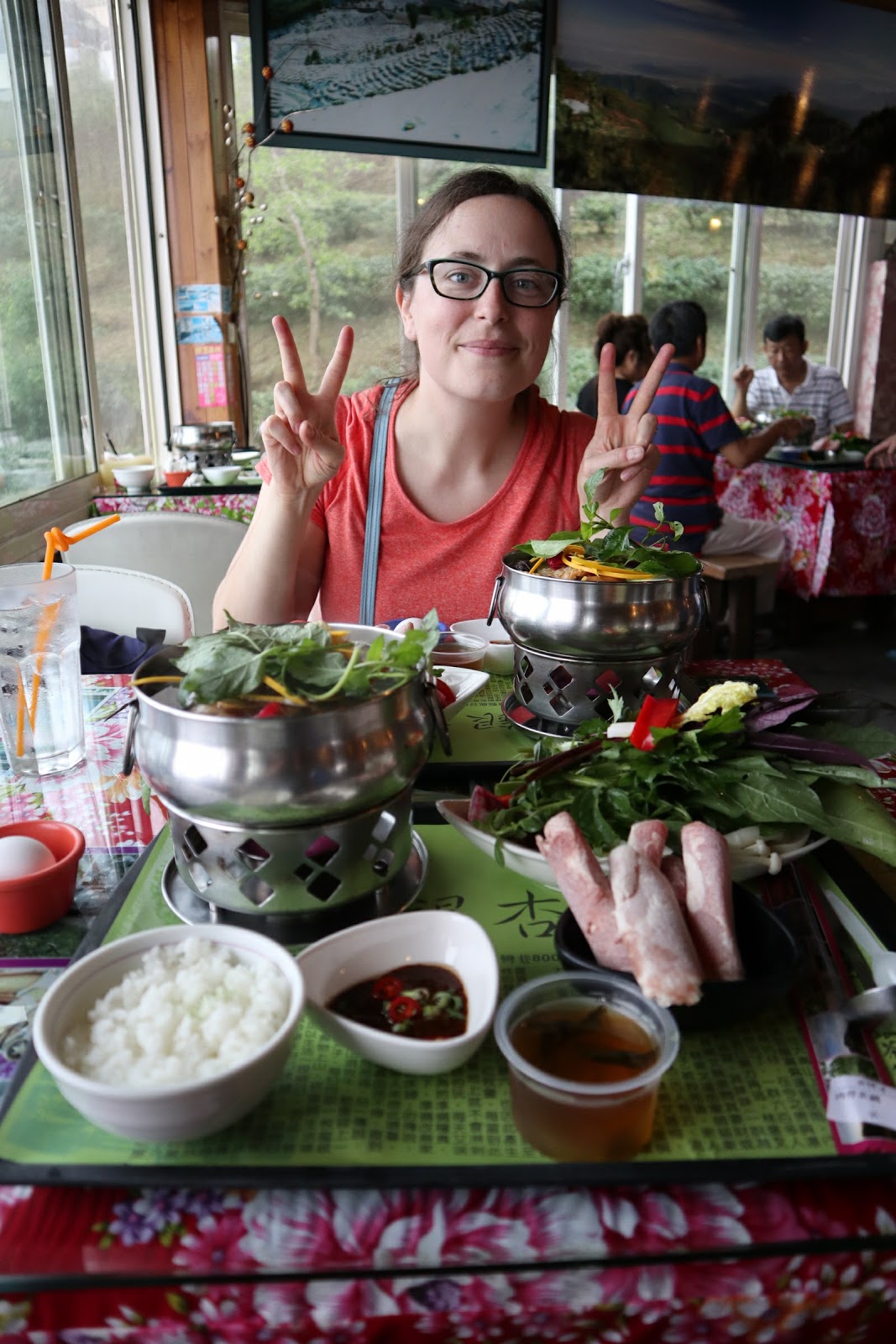
After we bought several packages of our favorites from among the teas we sampled, they sent us on our way up the mountain to the nearby 杉林渓 tea growing region, where they also had their farm. (I really wish I knew how to pronounce 杉林渓, but I don’t. It was like that for the whole trip: I knew the characters and their meanings, but not how to say them.) We had a beautiful hotpot with a wide variety of local vegetables for lunch.

Hotpot: a little bit of lamb and a lot of vegetables
High mountain tea farm!

Words (and pictures) don’t do justice to the delight of this experience, or to the regret I felt that we likely won’t meet these lovely people again. But I think I now know more fully the meaning of 一期一会 (ichi go ichi e): treasures of time to be enjoyed with thankfulness.

Sunday, May 28, 2017

Faking it

Today was the day when my fake smile cracked. It has cracked before--last Tuesday, at the Hokkaido pastors’ gathering, in fact--but I managed to hide in the back stairwell, sniffling, dabbing my eyes with a wet handkerchief, and fanning my face until it turned back to its usual shade of pale pink. But today, the gentle missionary facade that I had been cultivating started to crack at the church leaders’ meeting… because I can’t fake it anymore.

Faking is a performing art. I was just talking to Shino about faking when we were rehearsing the Rachmaninov cello sonata last Thursday. The cello part isn’t too difficult… but the piano part is beastly, written by a man whose hands were twice the size of Shino’s. Thus she was bemoaning the difficulty of a certain passage. “Just fake it,” I said in English. “Just fake it,” she repeated, smiling. I continued in Japanese: “The left hand is all that matters; the right hand is just decoration. Even if you flub half the notes, no one will notice,” I suggested. She looked unconvinced. “Well, you should certainly try to hit as many notes as possible, but don’t worry about it if you miss a few.”

Faking well is part of the performance. All musicians do it. Even if I make an obvious mistake in the middle of a concert, my face must not give away any sign that I didn’t play that note on purpose. After the concert, I must smile and graciously receive everyone’s thanks and compliments, even if I feel like a hypocrite.

Faking is a part of the performance of life around the world, but especially in Japan. Here we call it tatemae. Tatemae can be a good and healthy practice; we consider the feelings of other and think before we speak. Tatemae can also be an unhealthy practice when we hide what is truly in our hearts and build an entirely different persona to face the world, or perhaps a different persona in every social situation.

Introvert that I am, in some ways I appreciate this aspect of Japanese social interaction. I am free not to talk if I don't want to. Interactions with others tend to be respectful and peaceful. I have never been pressured to spill my guts in front of strangers in some sort of intimacy-building activity. I can take my time making friends, gradually sharing more and more of what’s in my heart. Shino is a friend like that; I’ve known her for eight years now.

And yet, I fall into the trap of building personas. I want to be strong for the church right now. I want people to like me, to think well of me. Celia the musician, Celia the missionary. I’m even different depending on what language I’m using. Celia speaking English, Celia speaking Japanese. But no facade can hold up forever. The shock of finding out that a person you thought was kind and gentle is actually vindictive and angry, for example, is distressing, to say the least. One feels lied to and betrayed. And yet, it shouldn’t be a shock to discover the darkness in another person’s heart, because there is darkness in all of our hearts.

Last Wednesday, we read James 4:1-10 together at the church prayer meeting. (I have been leading the group through James doing a made-for-Wakaba version of Lectio Divina.) For some reason, I really like this passage. Especially this part: “Be wretched and mourn and weep. Let your laughter be turned to mourning and your joy to gloom.” There’s something incredibly healing about grieving properly for things that ought to be grieved. Sin is grievous. It separates us from God and from one another. Here was an invitation to be real, to drop the fake smile, to stop pretending things were okay when they weren’t.

It wasn’t until after I went home that I realized how counter-cultural this passage was. As I observe the reaction of our church to our current challenges, it seems that the members instinctively try to patch things up quickly and move on, because we in Japan care about peace. But peace achieved by faking it--like covering a festering wound with a bandaid--won’t do any good in the long run. I need--all of us need--to grieve, to stop faking it. The road to recovery and reconciliation runs through the valley of grief. “Humble yourselves before the Lord, and he will exalt you.”

Wednesday, April 19, 2017

Tea in Kyoto

Back when I was thirteen, my family went to Europe for the first time. I still remember my excitement as we arrived in Salzburg. To a budding cellist like me who grew up on a steady diet of classical music, being in the same places and breathing the same air that Mozart had breathed was a magical experience.

After four years studying tea ceremony, our recent family vacation to the Kansai region (Kyoto and Osaka) had some of the same excitement. It was a much-needed break, but it was also an opportunity to visit historical sites related to tea ceremony! And also, it was a welcome opportunity to feast on good-for-you foods, since Kyoto is known for vegetables, pickles, and tofu. (I’m sorry to say that cooking is one of the many things that has gotten dropped around here lately…) Of course, we saw lots of other stuff too.

I was thinking of fangirling all over this blog post and dropping all sorts of names and such that most English-speaking readers have never heard of… but on second thought, maybe I’ll just do pictures. Read the captions if you are interested. Yay, Kyoto eye-candy!

Visiting the tea room at the Sen no Rikyu museum in Sakai!
The "nijiriguchi" door: can't bring a sword inside, because it won't fit. Everyone stoops to come inside; everyone is on the same level. Tea is all about reconciliation.
The site of Sen no Rikyu's home in Sakai, where he was born. 
We visited Kitano Tenmangu shrine to go to the flea market... and then I remembered afterwards that it was the site of Hideyoshi's massive chakai (tea party)! Also, the ume/plum trees were in full bloom; I remembered the "Tobiume" story that my tea ceremony teacher once told me; the hero of that story is said to be the god of this shrine. Yeah... as some of our friends from church say, Kyoto is so beautiful... conflicted feelings.
In the background is the garden and tea house built by Hosokawa Tadaoki, husband of Lady Gracia (a famous Catholic) and disciple/friend of Rikyu. It is called shokoken (松向軒), meaning "building facing pines." I planned the tea room in our house inspired by this one, so it was great to finally see the original!
The interior of 松向軒/Shokoken
The garden, appropriately with a pine tree
Before tea, guests wash their hands and mouth using something like this. I can't think of what we would call this in English... outdoor stone sink? This one in Hosokawa's garden was famous for being large.
This has nothing to do with tea, but Gion is very picturesque, even in the rain.
Yasaka pagoda at night. We stayed near here.
We wanted to climb all the way to the top of Mt. Inari, but... it got dark. The gates made interesting shadows.
Pickle buffet! Keith and I were thinking that this would be a good idea... and there it was! Very popular too; we had to wait about two hours to get in.
The buffet... I'm getting hungry again just looking at this picture.
I hadn't had enough pickles yet, so Mom and I had pickle-high-tea. Everything had pickles in it, even the desserts! This is also a great idea.
Plum blossoms at Nijo Palace, the Kyoto home of the Tokugawa family.
 And... if you want to see more pictures, there were over 700 of them. For once I took more pictures than Dad. ;)

Wednesday, July 27, 2016

Participation, Attendance, Service (and coffee)

Today’s coffee… was at school. 3 cups was probably too much. But considering the number of mistakes in my translation-work pre-coffee…

Speaking of coffee, it’s been hard to get to a café to write lately, since I’ve been in Japanese class every morning (and there’s a coffee pot always on, hence today’s 3 cups). By the time I get home, I’m too tired for the next several hours to do anything other than sit on the couch and stare out the window. Thankfully, Keith has finished peeling the annoying lace-patterned film off the living room window, so now I look out on a garden full of wildflowers, bamboo grass, boulders, and trees. (I think it was worth renting this house just for the garden…) So by the time I recover enough to go out to a café, it’s too late to drink coffee (and I already had 3 cups… I do want to get some sleep tonight…)

But I have been writing--a lot. Sometimes in my journal, sometimes poems which ostensibly are part of “Japanese study.” I included several poems in a short devotional talk I’m giving at our friend’s graduation from language school tomorrow. The biggest project I’ve been working on (also as part of my Japanese study) is translating my CD liner notes into Japanese. (Japanese version coming soon!!)

Translation work sucks--even though I’m just translating stuff I’ve written myself. I think it’s especially hard for those of us who are decently good at writing. Whereas I’m fairly eloquent when writing in English, in Japanese, I am not. This is frustrating. I know exactly what I want to say, and what nuance I want it to carry, and yet… Japanese is a completely different language, and some things just don’t translate. I found the same to be true when translating Japanese folk song lyrics into English for the CD liner notes.

Today I was working on the story which accompanies Rachmaninov’s Vocalise. (It’s a version of the main article in our February newsletter.) As I was expanding the explanation of what I had hoped to accomplish with my Regent arts thesis project and coming up with a translation for the title, I ran into a slight difficulty. The title is Praise the LORD with Stringed Instruments: Instrumental Music as Participation and Contemplation. After some discussion with my teacher, I translated the subtitle “器楽による礼拝への参加と黙想” which specifies that participation and contemplation happen in the context of worship. But this translation might not stick.

To give you some background, my arts thesis project was my response to a push in North American worship-leading circles for congregational participation. This has always been a big thing for us Protestants--we are the “priesthood of all believers,” so inviting everyone’s participation in corporate worship is hugely important. However, I found the definition of participation in most books I read to be troubling: most focused on doing and completely ignored being. Singing, moving, reading, speaking, and praying (out loud) were okay, but listening (sermon excepted), art which doesn’t communicate propositional truth, silent prayer and just being together in God’s presence with one's church family didn’t rate very high. Furthermore, spoken word took precedence over everything else, leaving little to no space for reflection. Therefore I explored nonverbal means of participation, especially through instrumental music, in my project. Vastly oversimplified, but that’s the basic idea.

The reason the translation of my title (and a lot of other parts of my arts thesis, if I ever get around to translating it) might not work is because, as my teacher explained, in Japanese we do not use the word participation (参加 sanka) to refer to what we do in worship. We use the word which means attendance (出席 shusseki). You don’t participate in worship, you attend worship. The most important thing is that you show up, even if you sleep straight through the service. (There was an interesting article on this phenomenon throughout Japanese society on BBC news recently. Not that I really have any right to complain about this. I was always the worst offender for sleeping in class through undergrad and two master’s degrees.)

And participation? That’s called service (奉仕 houshi), which means more like cleaning the church once a month or teaching Sunday school or taking your turn leading the service or doing your part for the church bazaar. Some kids in our youth group confessed that they didn’t want to get baptized because then they would be expected to do “houshi.”

It seems like a first step for arts ministry in Japan might be to redefine, together with my friends at church, what participation in worship looks like...

Edit: I just want to add that regardless of what it's called, many (most?) Japanese Christians do "participate" in worship. I was moved by the hearty singing at church last week. :) I'm looking forward to many conversations with friends as I seek to understand what worship means to each one.

Saturday, October 10, 2015

Tea ceremony, Pacific Northwest style

Today’s coffee: Rwanda (still drinking Tokumitsu coffee, which I’ve been hoarding…)

Yesterday was a long day: I did a tea ceremony presentation for high school students at Missions Fest Seattle. There were a lot of preparations, but what resulted was a uniquely Pacific Northwest style of tea ceremony. (It wasn’t necessarily “correct,” but sometimes it’s fun to be creative.) Let me explain.

Here's my setup. Unconventional, but that's not a bad thing.
Tea ceremony can be pretty expensive. There are lots of valuable (breakable) tools and accessories and clothing, so I try to get things used whenever possible. Here in Seattle, it’s hard to get tea ceremony equipment at all. But I have discovered some work-arounds for these problems, or, to put it in inappropriately casual terms, life hacks for tea ceremony.

There is a precedent for this way of thinking. Sen no Rikyu, the founder of tea ceremony as it is currently practiced, repurposed everyday objects for use in tea ceremony: peasants’ rice bowls became tea cups, tubes of bamboo became flower vases, and rustic iron cauldrons became kettles for tea water. I’m just putting Rikyu’s wisdom into practice… is what I say to justify myself.

I collected various tools in Japan and brought them to Seattle, but a hearth (furo) was too large and heavy. I figured I could find something comparable. Thankfully, the fruit stand at the bottom of the hill was selling their planter pots at half off for end of season clearance; I purchased a large (despicably heavy) brown clay planter.

This setup needed some work, though. First, I needed an electric burner to keep my tea kettle warm. I found one on Amazon for $13. Sweet!

Next, I needed a slab of wood to keep the planter from damaging the picnic mat I sit on when doing tea ceremony. The picnic mat itself was a life hack, since transporting tatami mats from Japan would have been nearly impossible. I asked my dad if he might be able to cut a cross section of a tree and clean it up a bit. In typical fashion, he took my simple request to a whole level beyond what I had expected. Dad chain-sawed a round off a log from a tree behind our house (part of the tree was rotten, so it had to be cut), then cleaned it up in his workshop.

The log.
Dad working on the cross section of log to make it pretty.
The gigantic coaster, as we started calling it, and the matching insert to adjust the height of the burner and tea kettle, turned out gorgeous.

My kettle (tetsubin), which I brought with me from Japan, hanging out in its new home (planter pot fitted with two slabs of maple tree). The tea tray in the foreground came from the same tree. And of course, my beloved picnic mat and tea basket.
I also needed a tea tray. I could have easily brought one home, since they are light and small, but my dad can make guitars, so a tea tray ought to be child’s play, right? Dad used many of the same techniques he uses for guitars (bent sides around a book-matched piece of maple from the same tree as the previously mentioned coaster).

Dad bends the side of the tea tray with his bending iron
Of course, I couldn’t imitate Rikyu properly without also scouring the house for interesting objects to use. I re-discovered a painted screen which had adorned my grandparents’ living room fall for decades, and set it up behind me to give the feel of being in a tea room. Keith carried sweets to our guests using a wooden tray my grandfather made. I also found a cute flower vase from our exchange student’s hometown in Wernigerode, Germany, which Mom filled with late autumn flowers from the garden.

We didn’t have enough chawan (tea bowls) for the number of guests we expected. Solution: Say hello to my first project in pottery class.

It's a bit lumpy, but it worked out fine.
Then of course we needed wagashi (Japanese sweets). Since it’s rare to find proper wagashi outside of Japan, my Seattle-area teacher makes all her own wagashi for our classes (I look forward to them every time!!) The only thing to do was make them myself! It’s autumn, so it was perfect timing to make the kuri manjū (chestnut buns) I learned to make from a friend at church. I also tried making kuri yōkan for the first time. (Mine didn’t look as pretty as hers.)

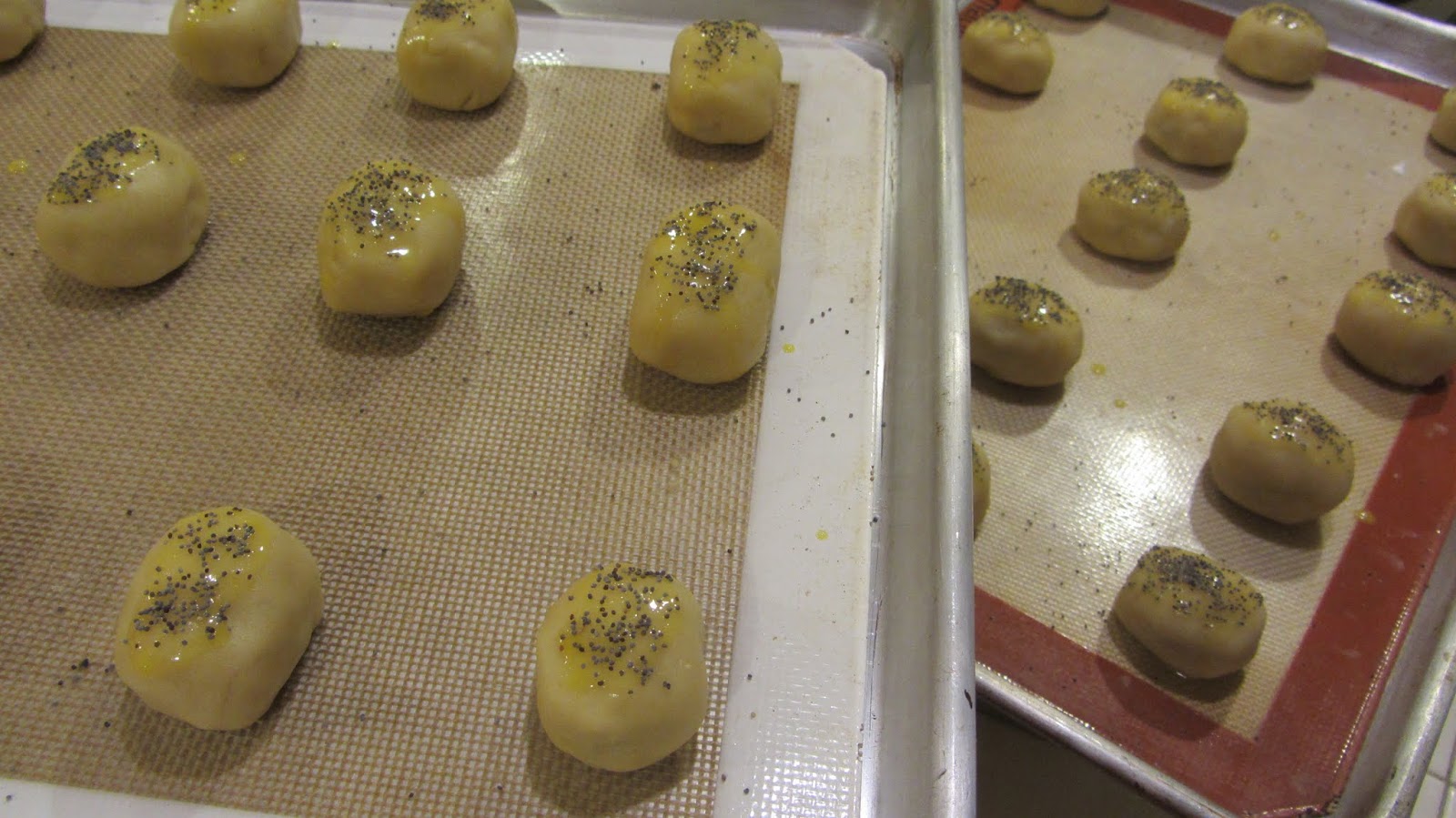
Here's what they looked like before they went in the oven. I forgot to take an after picture. Preoccupied with other stuff, I guess.
Finally, I needed helpers. Keith was an obvious choice for the hantō role, carrying tea and sweets to each guest while I prepare the tea. He had to kneel and stand 2 or 3 times in front of each person (about 30 total guests), amounting to the equivalent of about 80 squats. His legs are pretty tired, he says. After a last minute crash course (the day before), Mom took on the backstage helper role, standing at the back of the room while making tea and washing tea bowls, since I couldn’t go fast enough by myself.

Last minute practicing in our living room

Yesterday, I got up at what seemed like the crack of dawn to do final preparations, and off we went!

I thought there would be 10 high school girls for tea… but far more showed up than expected. After the first 14 or so, Keith started taking down reservations for a second session. Thankfully, I brought more than twice as many kuri manjū as I thought I needed.

This was session #2.
I served tea as part of a presentation in which I told stories about our life and work in Japan, talked about the history of tea ceremony, and then invited everyone to enjoy some quiet, reflective time while I prepared and served the tea. No rest for Keith or Mom, though. They were working hard the whole time.

This morning I had tea ceremony class. I enjoyed being served by my teacher and fellow students after experiencing firsthand the extent of the preparations for an ochakai (tea gathering). Next time there should be fewer tools to make from scratch, though.

Monday, June 15, 2015

Onsen Manjū

Sometime during home assignment I’m sure I’m going to have insatiable cravings for manjū, so I may as well practice now… and I’m putting off things I actually need to do by working on the all-important “cleaning out the pantry” project. There were beans that needed eating, also brown sugar. We’re moving, after all.

Onsen manjū are red bean paste filled buns which traditionally were steamed using natural onsen (hot spring) steam. They have a lovely molasses-like flavor from the 黒糖 (black sugar) in the dough.

Here’s my first attempt. I might post updates later if I have any better attempts later on…


Onsen Manjū recipe


Ingredients, for 12 manjū:
  • ¾ teaspoon dry yeast
  • 115 mL warm water
  • 175g flour, plus more for kneading
  • 50g “black” sugar (黒糖 kokuto) or muscovado sugar
  • ½ teaspoon salt
  • 7g melted butter
  • 270g tsubuan (sweet azuki bean paste), chilled
Ingredient notes: I used bread flour, but the dough turned out too… bread-like. I think next time I’ll use all purpose. You can get tsubuan at Asian supermarkets, but it’s easy to make with the recipe I linked. (You need the tsubuan to be pretty thick for manjū.)

Measurement note: yes, it’s metric. Get a kitchen scale. Baking will become so much easier. (I’m feeling rather lazy…)

Instructions:

Put yeast, warm water (~40 C) and a pinch of sugar in a cup, let stand in a warm place for about 10 minutes until it is frothy.

Sift together flour, sugar, and salt. Add the melted butter and yeast mixture, stir until all the flour is incorporated. Turn out onto a well-floured board or mat and knead for about 5 minutes until the dough is smooth. (You may need a lot more flour.)

Let the dough rise in a warm place for about an hour, until it has doubled in volume.

Divide the dough into 12 equal portions and shape into balls. Let rest for about 10 minutes. (Don’t go longer, since the texture gets weird if you wait too long.)


Meanwhile, divide the tsubuan into 12 little balls.

Shape each dough ball into a disc, so that it’s thicker in the center than the edges. That way it can stretch without breaking.


Set a tsubuan ball in the center of the disc, wrap the dough around, and pinch shut. Roll around in the palms of your hands until smooth. This takes some practice… but once you get it, you will have awesome dumpling-filling techniques for all kinds of snacks!


Put each manjū on a square of parchment paper seam-side down, then arrange them in a steamer.
Place the steamer (with the lid on) over boiling water and steam the manjū for about 20 minutes. (I just put a bamboo steamer directly into a frying pan with about 1 cm of water in it.)


You can eat your manjū hot or at room temperature. They are nice with a cup of green tea!


Friday, May 22, 2015

Goodbyes and finished projects

Today’s coffee: Affogato, Father's day blend

Preparations continue. I checked another thing off the bucket list: my yukata is complete! The fabric was my birthday present from my mom last year, chosen while on a family vacation—batik dyed cotton with a pattern that looks like fireworks or chrysanthemums, both of which are very appropriate for a yukata. And if you’re still wondering what a yukata is, it’s a casual summer kimono which is typically worn for evening outings, in particular, festivals and watching fireworks.

In my sewing corner
I promise, it was perfectly ironed when I put it on...
While I suppose I could have packed the unfinished yukata up to finish when we come back, I received a lot of helpful advice from Fujiyama-sensei, our tea ceremony teacher, who also teaches kimono-making. Sadly, Tuesday was our last class. I definitely wanted to show her my finished work, so I hurried to finish it, and then I wore it on Tuesday… despite the fact that the “rules” state that yukata are only for July and August. Not to mention, it was cold, rainy, and the wind was blowing like crazy—definitely not yukata weather. Oh well. Sensei’s living room was nice and warm, so I didn’t get cold.


As a special treat for our last class, Sensei made us a delicious supper consisting of various dishes using 山菜 (sansai—mountain vegetables), including lots of pickles for Keith. We will miss her warm hospitality, her encouragement, the way she gets excited and talks on and on about Japanese history, the way she corrects us to help us make tea more beautifully.

Itadakimasu!
Pickled cucumber, udo, tofu, and carrots, stir-fried fuki, udo tempura donburi, and miso soup with fresh wakame!
Thanks to her help, and the help of another experienced teacher in the area, I have been connected with a teacher in Seattle so I can continue my studies and start working towards certification.

Now I’m going to brag about my dad’s handiwork. I sent him pictures and measurements, and he copied a tea tray which is used for 盆略点て (bonryakudate), a simple form of tea ceremony, using gorgeous figured maple from our backyard. (I mean, he can make guitars and shamisen, so why not a tea tray?) Actually, he made two—we gave one to Fujiyama-sensei, and the other is waiting for us at my parents’ house… so be sure to come over for tea! Looking forward to seeing what other interesting things we can make in dad’s workshop to use for tea ceremony.


Dad used his bending iron (metal tube with a halogen light bulb inside) to bend the sides, just like making guitar sides.