Friday, August 16, 2013

Summer Camp

Today’s coffee, Ethiopian (from Tokumitsu) at home

It’s been quite a week. Keith preached on Sunday, then on Tuesday we headed to camp. When we came home (exhausted and seriously sleep-deprived) on Thursday, we headed straight to prayer meeting, then I went out for supper with my kimono club. Tired as I was, I can’t even begin to describe how wonderful it was at that point to talk to other adults about things I understood. Friday was spent catching up on all our weekly appointments—I had a rehearsal and a Japanese class. In the evening we had our pastor and his wife over for dessert. This morning (Saturday) we made a trip to the farm, where we harvested a bunch of stuff, including all the remaining daikon, and replanted the daikon for fall harvest. All very good things, and many learning opportunities… but I think I will be spending the rest of the day lounging around the house. Tomorrow will be a busy day too!

Returning to the subject of “camp,” I mean a 3-day gathering at a nearby youth hostel for kids (grades 5-12) from churches all over Hokkaido. From our church, there were about 8 kids and 3 staff. We decided to join the staff so we could support and encourage each of these kids.

I certainly wouldn’t call myself a natural youth worker. We are helping lead our church’s youth group because there is a need and because it is an important part of our training. I think the reason it is going relatively well is that we see most of these kids every week. We know their parents and their siblings, and even their grandparents in some cases. Most weeks we hear how their school and club activities are going, and we pray together. They’re like our family. We trust them, and they trust us. Probably.

But at camp, I was the odd one out. These kids were not my family—I was dropped in the middle like a student transferring schools mid-year, and I found it difficult to find anything to talk about. I had one kid from our church in my group of 4 1st year middle schoolers (US 7th grade), and Keith didn’t know any of his 5 kids, also 1st year middle schoolers. However, all of my kids, plus the other 4 1st-years from another group, knew each other. They had all been together last year and the year before. As they chatted excitedly about boys and pop stars and other subjects that I knew nothing about, I quickly got bored. Even when I was in middle school, I had no interest in pop stars. If I hadn’t been the group leader, I would have gone away and found some other way to amuse myself… but I couldn’t leave. I felt profoundly out of place. I found myself getting jealous of the other staff—they seemed to be getting on so well with their campers, but there was no way any of my girls were going to open up to me in the 3 days we had together. “What’s wrong with me?” I thought. “Is it because I’m not Japanese? Or am I too old?”

Then there was the ringleader of all the 1st years—a pastor’s daughter who pretended not to understand me when I told her to shut up and go to bed. She had all the “right” answers during devotion time, but somehow it didn’t seem that her heart was in it. I have to admit I was glad when she decided to do a different afternoon activity than the other 3 girls—then I was able to spend uninterrupted time with them on a walk through beautiful Hokkaido scenery.

The first 24 hours were misery. I wanted to go away by myself and cry, but I couldn’t. “God,” I prayed, “If anything good happens here, it’s not going to be my doing. Help!” Then I realized that this was also part of my training. Each of these girls could be the only church-attending kid in their class, or even their whole school. In a society that places such a high value on being part of the group, doing something that stands out can lead to isolation. I was feeling left out because I didn’t get along well with a group of middle school girls for just 3 days, but how much more does each one of these girls have to deal with isolation on a daily basis?

Towards evening on the second day, things started to go a bit better. I felt like someone was praying for me. (If it was you, thanks!) I also figured out some things for us to do together other than talking about boys and pop stars—I highly recommend a game which I call “Telephone Pictionary”; it’s fantastic in any language.*

On the walk, there was also a giant roller-slide. Fun! (3 girls from my group, and one from the other 1st-year group)
Other than games, other silliness happened.
Before we went home, we prayed for each other. Each of the girls asked for prayer for good relationships with others at school, in their classes and club activities. Maybe if there had been more time, we could have been closer, but I can certainly continue praying for each of these girls.

Both 1st-year groups and leaders together
Did anything good happen? Who knows; probably something good happened, but I may never see it. In any case, it wasn’t my doing.

*How to play "Telephone Pictionary": Sit in a circle (the more the merrier); each person writes a sentence on the top of a piece of paper and hands it to the next person. This person draws a picture based on what the first person written. He or she then folds the top of the page so the original sentence is hidden, and hands it to the next person, who looks at the picture and writes a sentence describing it. And so it continues until each person’s page comes all the way around the circle… at which point we open them up and laugh.

Telephone Pictionary sample. Translation, from top: "Celia's coffee has been stolen!" (picture) "Waking up while drinking coffee" (picture) "The boy drinks coffee and suddenly wakes up!" (picture) "Celia is surprised while drinking coffee" (picture) "A girl is surprised while drinking a hot drink."
Done with camp and out with other grown ups! And wearing yukata too! Yay!

Sunday, August 11, 2013

Summer Vacation

I've already posted a few times about our vacation last month. We went to Rishiri and Rebun islands, our church's retreat, and Niseko... as well as spending a few days relaxing at home. There were simply too many pictures to post, so I've put the best ones on picasa web albums. Here's a sneak preview!

From Rishiri and Rebun:

I highly recommend checking your hiking boots for rot before leaving home for a hiking vacation.
That did not stop us from going on a crazy 9-hour hike the next day (I wore sandals).
There was Edelweiss! I thought that only grew in the Alps!
Rishirizan

Not to be outdone, Niseko is also very nice, and much easier to get to!

At the top of Iwaonupuri
There were also delicious sausages.

There you have it. Now, go see the whole album if you're interested!

Friday, August 09, 2013

Sourdough Bread, part 1: My Sourdough Bread Story・天然酵母のパンのストーリー

Recently my Japanese teacher has encouraged me to translate my recipe for sourdough bread into Japanese. Before I did that, I had to write out the recipe in English. So, here goes: 4 part series on sourdough bread in English and Japanese! We’ll start with a story. (Thanks for your encouragement, Motoko-Sensei. :)

最近日本語の授業で先生とパンについてばっかり話していたので、先生は私が天然酵母のパンのレシピを日本語に翻訳するように勧めてくれました。しかし、その前に、ちゃんと英語で書かなければなりませんでした。 では、天然酵母のパンシリーズ、スタート! まずはストーリーです。 (もと子先生、励ましてくれて、ありがとうございます!)


Part 1: My Sourdough Bread Story・天然酵母のパンのストーリー

I love bread; I first made my own bread in college. I think at the time I couldn’t find good bread, but I probably wasn’t looking in the right places—I’m pretty sure that Boulder, Colorado is full of bread-making hippies. While in theological school, I became fascinated by fermented foods of all sorts—we couldn’t keep pets, so why not a sourdough starter or a bucket of sauerkraut? Now that I’m living in Ishikari, in the outskirts of Sapporo, I’m faced with a choice: eat “shokupan” (like wonderbread, only thicker slices) or pay through the nose for beautiful artisan bread—around 600 yen ($6) for half of a tiny loaf. Delicious, but not really doable on a regular basis.

私はパンが大好きです。 初めてパンを作ったのは大学生の時でした。 それはおいしいパンが大学の町の店で売っていなかったからだと思います。 多分本当は売っていたかもしれませんが、その時、いい店は見つけられませんでした。 神学校の時、ペットが飼えなかったので、その代わりに、ザワークラウトや天然酵母の種などの発酵した食物にすごく興味を持つようになって、飼い始めました。 つまり、ピクルスのオタクになってしまいました。 
今札幌市の隣の石狩市に住んでいます。 日本で本当においしい手作りのパンが売っていますが、高いですから、なかなか買えません。 食パンもありますが、残念ですがそれは私の好みの味じゃありません。

Solution: make my own sourdough bread! The starter I’m currently keeping has a history: I started it in our Vancouver kitchen in summer, 2007, then brought it home to Seattle and divided it with my mom and brother. When my family came to visit us in Japan in December 2009, my brother brought a little jar of starter (less that 3 oz. ;) in his carry-on luggage. Before we returned to the US in April 2010, I entrusted the starter to a German friend who kept it going until we came back. Now there are 3 of us in the Sapporo area making bread from my original starter!

解決は、もう一度天然酵母のパンを作ることです! 今飼っている天然酵母の種は歴史があります。 2007年の夏、私のバンクーバーの台所で発酵し始めました。それから私はシアトルの実家へ種を持って行って、母と弟に分けました。 2009年の夏に初めて私は日本へ来てその後、家族がお正月に遊びに来た時、弟が小さい瓶に種を入れて、それを持って来てくれました。 私がアメリカへ帰国する時、札幌に住んでいるドイツ人の友達に種を預けました。 日本へ戻ってから、ドイツ人の友達からまたその種をもらい、今札幌に3人、シアトルに2人が私の種を飼って、パンを作っています!

The instructions and recipes which I’m going to share here are the result of many years of experimentation. Actually, I’m still experimenting; I rarely measure ingredients any more, and I tend to use whatever looks good at the time. If you have any good ideas, please do write a comment, and maybe I’ll try your suggestion next time.

これからアップするレシピや説明は6年間の実験の結果です。 実は、今も実験しています。 普通は材料を量らないで、冷蔵庫と食品庫と相談して、おいしそうな材料を選んでパンを作っています。 :) 何かいい考えがあったら、どうぞ、コメントを書いて下さい。 次回は皆さんのお勧めを作ってみますよ。

Part 2: Making and Caring for Sourdough Starter・天然酵母の種作りと種の世話
Part 3: Sourdough Pancakes・サワードー・ホットケーキ
Part 4: Sourdough Bread・天然酵母のパン

Thursday, August 08, 2013

Japanese and Western cooking: what's the difference?

Today’s coffee: Costa Rica, Ethiopia (Yay, back at Tokumitsu again!)

The garden has been going crazy lately—I’ve got more produce than I know what to do with. The weeding is pretty much under control, but I really underestimated the amount of time it takes to harvest and process everything… but since “waste not, want not” is my missionary-budget-motto, I use everything I possibly can.


That being said, it’s really helpful when people come eat our food at our house… provided they don’t bring too much food with them. It’s customary in Japan to bring something to share when you eat at someone’s house. Last Saturday, we had several friends over for Baroque music sightreading (3 gambas and 2 recorders!) and barbeque. They brought drinks, watermelon, snacks, and dessert—we didn’t actually eat the watermelon, and 11 or the 12 mini ice creams also didn’t get eaten, since the dessert I made was very filling. The weather was beautiful; it’s been a long time since I sat outside and had a leisurely supper with friends.

The ice creams and watermelon ended up being very helpful since I bit my tongue eating breakfast on Monday and couldn’t eat properly for about 3 days. Ouch. Thankful also for our immersion blender and the lovely fresh tomatoes that we made into soup. And I’m thankful for my now fully functional tongue. I underestimated its usefulness…

With the garden flourishing and friends coming over to eat with some frequency, I continue to think about showing hospitality, in particular to my Japanese friends. I intend to return to this topic many times, but I’ll start with a few thoughts about hospitality in general.

First, it’s not about me. As I wrote last week, hospitality means making guests feel comfortable. It’s not about me showing off my cooking skills.

Style of hospitality and food should depend on the guest. For example, which guests are adventurous eaters, and which ones aren’t? Which guests will appreciate and enjoy eating off of our Royal Copenhagen dishes, and which will be worried about breaking them? Will the guest feel more at home if we leave the house in a “lived-in” state? If I’m having my baroque music friends over—most of them have been overseas many times—anything goes as far as food is concerned, but probably keeping the atmosphere relaxed is good. If I’m inviting guests my parents’ age and older, I will want to make sure all the preparations are done before they arrive, and I will want to be careful what sorts of food to prepare. The purpose of careful preparation and choice of food is to make guests feel at home in our house.

What kind of food might be appropriate? Since the taste-test lunch, I’ve been thinking a lot about the differences between Japanese and Western cooking, and how to make the most of Japanese cooking techniques and philosophy when preparing Western food.

In US home cooking, we often have one-pot meals. These are convenient and easy to prepare and clean up. They tend to have a lot of ingredients, providing a balanced meal in a single dish. The blended flavours are highly valued. However, in Japanese cooking, one-pot meals are rare. Usually a meal with consist of rice (御飯—gohan, the word for cooked rice, literally means “meal”), one or more meat and vegetable “side dishes,” soup, and pickles. Each dish has only a few ingredients; when I first started cooking from Japanese recipes, they seemed overly simple, and I was inclined to make a lot of additions. That wasn’t necessarily a good choice; authentic Japanese cooking allows each ingredient to be appreciated on its own. Using in-season, fresh ingredients and cooking techniques that minimize loss of flavour and colour are very important.

In Western cooking, we use a wide variety of herbs and spices to flavour our foods. Growing up in the US, being the melting pot that it is, I was exposed to foods from all over the world. I learned to cook from my mom, whose cooking is influenced by her Midwestern parents; my dad, who excels at experimental and fusion soups and stews; our Swedish-descent neighbours; our German exchange student; and my Taiwanese college roommate. In my cooking, I tend to use a wide variety of flavours from each of these cuisines and others as well. In Japanese cooking, flavouring ingredients typically consist of what I call the “5 s’s” or “the usual suspects”: shoyu (soy sauce), saké, mirin (sweet saké), shio (salt), and satou (sugar). With a vast number of interesting techniques and wonderful seasonal produce, there are endless possibilities even within this seemingly narrow flavour profile.

When Western recipes are adapted to Japanese taste, the number of ingredients is vastly reduced… and we call it 洋食 (youshoku—western food). I compared 2 recipes for minestrone soup: the recipe from a Canadian cookbook had 24 ingredients, whereas the one from a Japanese magazine had 12 ingredients. I remember ordering Spaghetti Carbonara once at an Italian restaurant in Japan; I was surprised when it came with a poached egg on top (rather than the egg being incorporated into the cream sauce), and no pepper. As I mentioned before, the ingredients are meant to be enjoyed individually.

When my friends at church explained what they thought needed to be changed from my proposed lunch menu, they specifically suggested that the herb flavour was too strong for elderly guests. At first I was surprised; the Japanese herb, shiso, also has a strong flavour (and I thank God every time I eat it). Then I recalled the conversation in the kitchen while cutting up the mint: “Ah, reminds me of toothpaste,” said one of the helpers. Mint=toothpaste or tea, not a topping for a savoury dish. I further recalled the aforementioned Taiwanese college roommate turning up her nose at rice pudding: rice is savoury, not sweet, she explained. Specific flavours (cilantro, etc.) may not suit some people’s tastes, but certain combinations of flavours are also off-putting to some people. Please do leave comments if you have ideas about combinations and specific flavours to try or to avoid!

I have a lot of further study to do in this area; I think for me, learning to adapt Western recipes according to Japanese taste might be more difficult than learning to cook Japanese food. I think the way forward is to cook Western recipes from Japanese cookbooks, and to continue to experiment with my own recipes… and invite trusted friends over to be taste-testers. Any volunteers?

Friday, August 02, 2013

Lasagne, and Speaking the Truth in Love

Today’s coffee: Brazilian (at home again… I tried to go to my café, but they’re temporarily closed! Oh, the pain!)

I feel like I’ve spent the week recovering from lasagne. We had an outreach event at our church—a movie called Shiokari Pass and meal afterwards. I was in charge of the main course—there ended up being 7 lasagnes, all lovingly made from scratch, down to the pasta sauce and noodles.

My baking set-up, with all 7 lasagnes in progress


Lasagne is not a summer dish. I’m thankful that it ended up being not a very hot day—and the lasagnes were baked on the second floor of the church, and not in my house. But we did use my oven. It’s large by Japanese standards, but this is not the first time we’ve taken it out of the house for a major cooking project. It’s surprisingly portable. But in any case, we used fresh zucchini from our farm and our friend’s farm and fresh Hokkaido tomatoes (10 pounds of them)—I wanted the lasagne to be a 「旬を味わう」(shun wo ajiwau—taste the season) sort of dish, so I think we succeeded. It’s definitely better with fresh tomatoes. It was also a lot of fun to teach three other church members to use the pasta roller to make the lasagne noodles! The consensus is that we should definitely make fresh pasta again sometime.

Setting the table
The menu: green salad with balsamic vinaigrette, fried mushrooms, vichyssoise, lasagne, focaccia, babaloa, and orange cake (not pictured)
Actually, the story I want to tell today is about the test meal I made on July 5. Originally I hadn’t intended to make lasagne—it’s too fussy and hot, and we don’t have enough pans. My first thought was that we ought to make Hokkaido specialties to go along with the movie, which was set in Hokkaido, but the consensus was that Western food was more interesting to our guests. Therefore, the menu I presented to the committee was the following:
  • Individual Pasta Gratin
  • Summer Minestrone
  • Insalata Caprese
  • Beans with gorgonzola and basil
  • Focaccia Bread

We are blessed to be part of a church full of people who are passionate about food. They’re not food snobs, but they love to eat together, and to be creative in the kitchen. So, the initial reaction to the menu I presented was very positive. However, just to be sure (and because it was my first time putting together a meal for 30+ people), we decided to do a test lunch.

The test lunch in itself was a lot of work. I translated all the recipes into Japanese (and got them corrected), with a few alterations based on local substitutions. I went to Costco and several grocery stores to gather ingredients. I made yogurt-cheese using a tofu mold to substitute for the mozzarella, which is prohibitively expensive. And then of course the day of the taste test, I instructed all the helpers on how to make each dish.

At the time, the meal seemed to go off without a hitch. Everyone said it was good. We talked about portion sizes and how to arrange things on the dishes. Everything seemed to be moving forward.

Getting ready to eat lunch... and checking the video equipment while we're at it!
That night, we had supper with some friends who had been living overseas—our friend Mikiko and her Ghanaian husband, Curtis. Mikiko, who is something of an adventurous eater, shared about the challenges of learning to love Ghanaian food and how much she missed Japanese food, especially when dealing with morning sickness. Curtis, on the other hand, talked about his struggle to get used to some Japanese foods.

To some extent, that conversation prepared me for the phone call I received the next morning. It was one of the committee members—a dear friend, and fellow food lover. “It’s hard to know how to say this,” she began. “The meal was delicious, but we’re worried that it won’t suit the taste of the elderly guests whom we hope will attend the event. You worked very hard yesterday, but would you please consider changing the menu?”

In the short silence that followed, a wide range of emotions washed over me—first sheer exhaustion, then shock, then indignation, then hurt—but somehow in the midst of all of it, thankfulness. Why thankfulness? I was thankful that my friends trusted me enough to speak the truth in love. They know I care about food and hospitality, and they know I deeply value opportunities to learn about Japanese culture. The conversation was an invitation to learn new ways of showing love to Japanese people.

That’s not to say I wasn’t hurt. I think it took a week before I was able to think constructively about the situation. Food is very personal to me, so criticism can be very hard to take. Thankfully I was on vacation, so I didn’t really have to think about it. I kept repeating “It’s not about me” over and over and over.

It’s not about me, and yet it is—this is also a part of my training. Showing hospitality and cooking according to Japanese taste are skills I need to learn. Learning to cook Western foods in a Japanese style might be more difficult than learning to cook Japanese foods. I have a lot of ideas about what was “wrong” with the meal I prepared and about the differences between Japanese and Western cooking, but that’s a huge topic for another post, or maybe several.

So somehow we ended up making lasagne, despite its not being a summer dish. I suppose lasagne has less odd gourmet sorts of flavour combinations… and it is sort of a specialty for Keith and me. The challenge was that we don’t have a recipe. There’s a great expression in Japanese: 「冷蔵庫と相談する」(reizouko to soudan suru—to discuss with the refrigerator); that’s exactly what we do. We open the refrigerator… and what looks like it goes in lasagne? In it goes. We had no idea how many kg of tomatoes and such we would need. Somehow we ended up with more than enough ingredients, but not too much more than enough.

I think the lasagne went over well. The portion sizes were a bit large—the small-ish elderly woman sitting next to me very kindly finished the entire slice because she knew I made it, but I felt a bit sorry for her, because I was also feeling uncomfortably full. ;)

I’m generally feeling a lot better about the situation. The hurt feelings are gone, and I’m left with thankfulness for the honesty and trust shown by our friends and for the new cooking challenges ahead of me. I also have some great recipes which I translated into Japanese, if you’re interested. :)

Thursday, August 01, 2013

夏のランチ

最近教会でこのランチを好きな人達と一緒に作って食べました。 レシピをちゃんと日本語で書いたので、ブログにアップしないともったいないと思いました。 よかったら、この料理を作ってみて下さいね。 :)


カプレーゼ

材料 (3人分)
  • モッツァレラ・チーズ、または水切りヨーグルト、120g
  • トマト、1個
  • バジルの葉、6枚
  • バルサミコ酢、少々
  • オリーブ油、少々
  • コショウ、適量
作り方
  1. モッツァレラ、トマトを7mmのスライスに切って、バジルの葉と重ねる。
  2. バルサミコ酢、オリーブ油、コショウをふりかける。

母のインゲン豆

材料(6人分)
  • インゲン豆、450g、すじを取って、食べやすい長さに切る
  • ゴルゴンゾーラ・チーズ、大さじ4
  • バジル、大さじ2、みじん切り
  • コショウ、適量
作り方
  1. インゲン豆を蒸し器に入れて、12分ほど蒸す。 水をきる。
  2. 温かいうちにゴルゴンゾーラ、バジルを加えて、混ぜる。 コショウをかける。

夏のミネストローネ

材料(12人分)
  • キドニービーンズ、150g
  • オリーブ油、大さじ2
  • 玉ねぎ、2個、1センチの角切り
  • 塩、小さじ1/2
  • ローストにんにく**、大さじ4
  • バジル、小さじ1 (または生バジル、大さじ1)
  • オレガノ、小さじ1 (または生オレガノ、大さじ1)
  • タイム、小さじ1 (または生タイム、大さじ1)
  • 赤ワイン、120cc
  • 水、約1400cc
  • トマト、1.5kg(皮をむいて、角切り)、または缶詰のトマト3個+ハチミツ大さじ1(缶詰のトマトはそのまま入れても良い)
  • 人参(中)、2本(皮をむいて、角切り)
  • じゃが芋、一個(皮をむいて、角切り)
  • セロリ、2本(5mmの長さに切る)
  • 赤ピーマン、一個(角切り)
  • ズッキーニ、1本(1センチの半月切り)
  • ほうれん草、1束(1センチの長さに切る)
  • 塩コショウ、適量
  • パセリ、適量(みじん切り)
作り方
  1. キドニービーンズをやわらかく煮る。
  2. 厚鍋を弱火にかけて、オリーブ油を入れる。 玉ねぎ、塩を加えて、玉ねぎが柔らかくてきつね色になるまで混ぜながらゆっくり炒める。 30分ほど炒める。 
  3. ローストにんにく、バジル、オレガノ、タイムを2.に加えて、2分炒める。 赤ワイン、水、トマト(とハチミツ)を加えて、煮立てる。
  4. 人参、じゃが芋、セロリ、赤ピーマンを順番に切って3.に加える。 やわらかくなるまで火を通す。
  5. 野菜がやわらかくなったら、ズッキーニ、1.のキドニービーンズを4.に加える。 やわらかくなるまで煮る。
  6. ほうれん草を加えて、ひとまぜし、火を止める。 塩コショウで味をととのえる。 ボールに入れて、パセリをふりかける。

パスタ・グラタン

(元のレシピはここですが、私はちょっとレシピを変えました。)

材料 (6人分)
  • 油、またはバター、適量
  • レモンの皮、適量、みじん切り
  • ドライ・パスタ、250g
  • ドライ・トマト、3個、はさみで小さく切る
  • カボチャ(中)、4分の1、1センチの角切り
  • ほうれん草、1束、1センチの長さに切る
  • バター、20g
  • ソーセージ、6本、1センチの長さに切る
  • 玉ねぎ、1個、1センチの角切り
  • ヨーグルト、500cc
  • 卵の黄身、2個
  • ローストにんにく**、大さじ2
  • 塩、小さじ1/2
  • オリーブ、15個、種を取って、みじん切り
  • おろしチーズ、70g、またはフェタチーズ
  • ミント、大さじ3、みじん切り
  • コショウ、適量
作り方
  1. キャセロールに油、またはバターをぬって、レモンの皮を入れる。
  2. 大きい鍋にたっぷりの水を沸かして、パスタ、ドライ・トマトを入れて、アルデンテ(かた目)にゆでる。 カボチャ、ほうれん草を加えて、20秒位ゆでる。 ゆでたお湯は、おいしいので、とっておいて、別の料理に使って下さい。:)
  3. フライパンでバターを溶かす(中火)。 ソーセージ、玉ねぎを加えて、玉ねぎが柔らかくなるまで炒め、火を止める。
  4. 大きいボールにヨーグルト、卵の黄身、ローストにんにく、塩を混ぜる。
  5. 4.に、2.、3.を加えて混ぜる。 それを1.のキャセロールに入れて、オリーブとチーズを上にふりかける。 200℃のオーブンで25-30分間焼く。
  6. きつね色になり、プツプツして来たら、オーブンから出して、ミント、コショウをふりかける。

**ローストにんにくの作り方: にんにくの皮をむいて、ボールに入れる。 オリーブ油、塩コショウをかける。 オーブンの皿に載せて、180℃のオーブンで30分程焼く。 フードプロセッサーでつぶして、ペーストにする。 

Friday, July 26, 2013

Sounds are also part of the feast

Today’s coffee: Brazil (brewed at home, again…)

I had very good intentions of going to the café yesterday and taking a leisurely hour or two for writing. However, “lasagne for 35+ people” happened. Or rather, shopping, making herb salt and roasted garlic, and preparing the meat sauce happened. Today is the big day; I make the cheese (yogurt) filling and the noodles and put the whole thing together. I hope we have enough pans… and since I don’t actually use a recipe for lasagne, I really have no way of judging if I’ve purchased enough ingredients or not. It certainly looks like a lot!

Anyway, in my home country, it is still Friday. That counts, right?

We’ve been on vacation, for almost 3 weeks, if you include the church retreat. I have to say; coming home from vacation (and preparing to go away, for that matter) really hurts. Emails don’t stop coming just because I stop checking. Japanese flashcards don’t stop piling up. The farm doesn’t stop producing vast amounts of zucchini. And we really should write another prayer letter soon.

The last bit of our vacation was 2 nights at Niseko, a ski resort about 2 hours away from here. We went there (during the winter) with my family 3 ½ years ago, and this time we stayed at the same hotel… I knew the onsen and food were amazing, so why look further? A friend of ours is a pastor there, so we visited his family too.

For me, having time away at an onsen is a special spiritual retreat. I don’t have to cook or clean up, there are none of the distractions of home and work, and onsen resort towns tend to be in beautiful places—I can relax and listen for God’s voice surrounded by his creation.

On the morning of our second day, we went on a hike. (It was great—not too long or difficult, but interesting, lots of wildflowers, and great views. The mountain is called Iwaonupuri, if you’re interested.) On the way down it started to rain, but that made the onsen feel even better when we got back to the hotel.

At the peak of Iwaonupuri
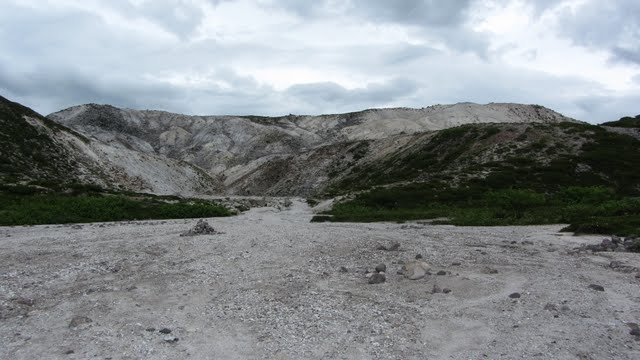
Iwaonupuri is a volcano; this is the crater. Smelled a bit like eggs.
View out over the Sea of Japan

Some kind of wild rhododendron

As I was sitting alone in the outdoor pool, I asked for God to speak to me. God brought to mind something that our tea ceremony teacher once said: 「音もごちそうです。」 “Sounds are also part of the feast.” Our teacher was referring to the fact that tea ceremony engages all the senses—not only do we enjoy drinking tea and eating sweets, but there are beautiful things to look at, and the various sounds of preparing the tea are beautiful and refreshing.

So I listened. The wind, the rain, the birds, the sound of water flowing into the onsen became a part of the “feast” as I enjoyed God’s creation.

Later in the afternoon, we went to the deck on the roof of the hotel. We’ve just finished a sermon series on the Sermon on the Mount—I think probably our third or fourth sermon series or Bible study on that topic in the last 3 years or so. I decided to read the whole Sermon (Matthew 5-7) again, while watching the swallows dart around above us. “Look at the birds of the air; they do not sow or reap or store away in barns, and yet your heavenly Father feeds them. Are you not much more valuable than they?”

This particular passage has always been close to my heart. I think that’s because I always need another reminder to trust in God’s provision—he will give me what I need, even if I think my “needs” are different. He wants me to ask and to trust. I need not be afraid that my prayers will not be heard or my needs left unmet.

The feast in the hotel dining room
Praying for God’s provision for my first attempt at a major cooking project. Today is the first part of an outreach series—we’re watching a movie together (Shiokari Pass) and discuss over a meal. Of course, the meal is Lasagne. More on that next week. :)

Friday, July 19, 2013

On holiday, and camping in Japan

Today’s coffee: coffee roasted by the pastor of our previous church (what a multi-talented guy!) and brewed at home by me.

We’re on holiday. We spent a week on a couple of islands off the northern tip of Hokkaido, but now we’re having a “staycation” week. The week away was really fun, but planning it was kind of stressful… so we really needed some restful time at home. Today we went for a picnic and walk in a nearby park; now we’re hanging out in the living room watching sumo on TV. Then we’ll probably watch a movie or something later.

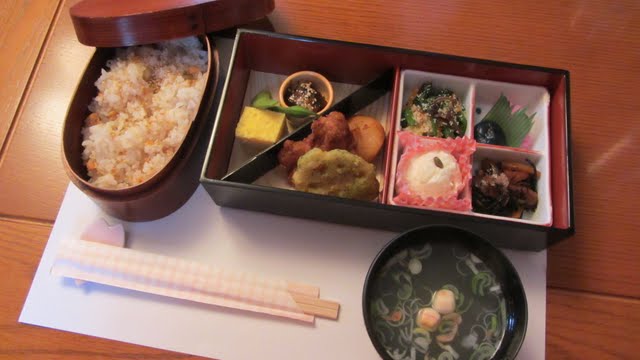
Today's picnic bento
We went to Yurigahara koen (the "lily park") at just the right time!
Red dragonfly perched on a red lily
I posted earlier this week about camp cooking. As you can see, we went camping—our first Japanese camping experience. And it was quite different than our experience camping in the US. There were no individual sites, just an open field and communal dish washing facilities (which are very convenient, I might add). No showers—why bother when there are onsen nearby?

Our campsite on Rebun
The biggest difference, however, was the people. The first night, other than the two of us, all of the other campers were men traveling alone, some carrying their gear on motorcycles or bicycles. They went to bed early—I heard one guy snoring away in his tent at about 7:00 p.m. There were no late night guitar solos or campfires or drunken parties like in American campgrounds. Well… we had a campfire. It was in our “grill.” But no one else did.

Why was everyone so quiet and well-behaved? My theory is that if you don’t go to bed early, you’ll be pretty tired still when the sun comes up at 3:30 a.m. You won’t want to get up when it gets too hot to stay in the tent (in the open field—no shade!) at 6:00 a.m.  But it’s too hot, so up you get. There you have it.

If I get really ambitious, there may be a post about the hiking we did on our trip sometime in the next few days… but only if I feel like it. I’m on holiday, after all. :)

Monday, July 15, 2013

Camp Cooking

We've been on vacation. Well, we're still on vacation, actually, but we're at home... but if you ask me to do anything, I'm going to say no. :) Last week was our 8th wedding anniversary, and also the 10th anniversary of the night on the sand dunes by Lake Michigan when, during a romantic starlit walk, Keith said "Well, I guess we're dating now." Happy anniversary, us.

So, in celebration, we went on an exotic island vacation to two small islands off the northernmost tip of Hokkaido. I should perhaps mention, perhaps, that the location was quite remote, cold at night, and we camped. Also, not much in the way of grocery stores or restaurants, except for shops selling kombu seaweed and uni-don (raw sea urchin on a bed of rice).

So... camp cooking was in order! And I have to say, we ate pretty well. Here are some highlights.

The first is uniquely Japanese, although I don't think many Japanese have this meal while camping. However, I'm sure this will be the new wave in camp cooking. You can have delicious rice, meat, and vegetables all in the same little pot! It's called kamameshi.

Thanks for the mini-kama (the little pots with cooking stand) and camping table, Mom and Dad! We used some of the anniversary money. :)
We have it several times on our trip, but this time it had poached and marinated chicken (this recipe with chicken breast substituted for the pork), daikon, and slivers of local kombu seaweed, with homemade radish pickles on the side. Delicious! (On this particular day, we had hauled all our gear to a park by the ocean to watch the sunset... which was underwhelming... although the previous night and the following night were both spectacular. Oh well.)

Waiting for the kamameshi to cook, with Mt. Rishiri in the background
Kamameshi, ready to eat!

Itadakimasu!
We also had aluminum foil wrapped packets cooked in the coals of the campfire. The first time it was potatoes, but the second time was daikon, chicken, carrots, and furikake made with some greens from the garden. It's a cooking technique Keith's been using for ages, but with a bit of a Japanese twist using local ingredients--we got the daikon from one of our neighbors at the farm!

Keith's favorite part of camping: making a fire and cooking over it.
Meat and vegetable packets over the fire!
Not cooking fast enough; Keith put the packets right in the coals.
Ready to eat! Served over rice cooked in the mini-kama.
Right when we came back, we went for an overnight retreat with our church, so of course there was Japanese-style barbeque--"Jingis Khan," which is a Hokkaido specialty of lamb and vegetables cooked on a cast-iron pan over the fire.

Jingis Khan! (The zucchini came from our farm--a bit of an unusual ingredient, but delicious!)
Keith with the youth group boys
Everyone helps when cooking Jingis Khan!

Thursday, July 04, 2013

Café Meguri

Today’s coffee: Nicaraguan coffee from Tokumitsu, ground and brewed at home. :) Busy day today… now is the only time available, and Tokumitsu doesn’t open until 10!

There’s a cultural difference for you. In America, we expect our coffee shops to be open by 5 or 6 a.m. so we can get our early morning fix, right? I’m not sure about Starbucks (I’ve never been in the vicinity of one that early in the morning), but most cafés in Japan seem to open around 10 or 11 a.m. If I want early morning coffee, I have to make it myself. Thankfully there’s a coffee-otaku nearby who taught me how to make good coffee.

Sharon demonstrates the correct way to make coffee with an aeropress. Also, there's some tasty stuff in the picture. That was this year's Osechi (new year's feast)
Not just one, actually. The pastor at our previous church roasts his own coffee… and it’s good! When we went to visit him, he brought out the coffee siphon. Fun!

Actually I had intended to write about tea ceremony today, but things seem to have taken a coffee sort of turn. So let’s talk about coffee.

Back in April, my friend, Sharon (the previously mentioned coffee-otaku) and I decided to do a coffee crawl in Ishikari and the northern parts of Sapporo. When explaining to a Japanese friend what we intended to do, I discovered that there is actually a Japanese word: カフェ巡り(café meguri). “Meguri” means going around; it can also be attached to “onsen”—温泉巡り(onsen meguri). I also like to do that. Good word, yes?

The first café we visited was Café Olive. It’s run by a church. Keith and I went there for lunch before, but the lunch was spectacular and filling, so we didn’t need dessert. (Not that you ever “need” dessert…) I absolutely wanted to try the gobo (burdock root) chocolate cake, so I’m glad we went again! It was tasty and a bit crunchy from the gobo… and I felt so virtuous eating a dessert with gobo in it.

Sharon, with our desserts.

Gobo chocolate cake!

Next stop was Sakura, which is not too far from our house. Fantastic lunch… and no room for dessert. Although the focus was supposed to be coffee, we actually didn’t have any there.

Lunch set at Sakura!
Although I checked the intended third café’s website, I must have made a mistake, because it was closed. :( Instead, we took a very cold walk on the boardwalk at the beach… and quickly gave up and went to the next place.

A great day for coffee, but not so much for taking a walk.
The last stop was Tokumitsu, which I discovered was about a 3-minute bike ride from my house. It came highly recommended from a number of coffee-loving friends. Noriko, a friend from church, joined us. I have to say Tokumitsu wins the “best coffee” prize… but that’s not surprising, since it’s a coffee specialty shop. There aren’t any cakes or cute handmade items for sale—just coffee. It’s a nice spot to sit and chat with friends.


Enjoying the Japanese tradition of "taking pictures of food and drink"
Which brings me to the “why” of it all. Of course we were searching for good coffee and good food. But I was also looking for places to meet friends, and places where I can go to relax or to get work done if home is too distracting. I’m also interested in cafés as ministry—places where people in the community can gather and care for one another.

I’m glad there are some good options nearby!

No post next week, probably... we're on holiday!