Showing posts with label 一期一会. Show all posts

Tuesday, December 10, 2019

Matthew 11 for Me

A couple of weeks back, I was working on Advent liturgy... and this sort of happened. I hadn't written a poem in months, and this one got written in five minutes. It was definitely meant for me, but I share it here for all my friends and colleagues during the breakneck Christmas season. May you find rest, friends.

Come to me, all you who are busy and self-important,
 And I will make you humble.
  Take my work upon you and do it with me—
   For I have all the time in the world to help you—
  Stop this meaningless spinning of plates.
 For my work brings joy
To those who lose their self-imposed burdens that they might gain eternity.

全て忙しい人、そこにプライドを感じている人は私のもとに来なさい。
 私はあなたがたをへりくだらせたい。
  私の仕事だけを引き受けて、私と共にそれを果たし、、、
   私があなたを手伝う時間は永遠に続くから、
  あなたの意味のない頑張りをやめなさい。
 私が与える仕事が喜びに至る人は
自分で背負い込んでしまった重荷を永遠を得るために手放す人です。


Friday, September 14, 2018

The Unexpected Sabbath

Last week was rather “exciting.”

On Tuesday night, the most powerful typhoon to hit Japan in 25 years came through the Sapporo area. I spent much of Tuesday bringing plants inside and securing things in the garden. Then I put in my earplugs and tried to sleep. The earplugs didn’t block out the house shaking, though.

Wednesday, Keith painted the living room ceiling. This had been on the to-do list for… oh, a year or so. I met a friend for dinner in Sapporo; I made my way home amidst a dramatic lightning storm as the typhoon bid us farewell. I was tired (no sleep the night before), so I went straight to bed.

And… no sleep for Keith and Celia Wednesday night, either. We woke up to the house shaking again—a large earthquake—shortly after 3 a.m. Thursday morning. As my cell phone’s earthquake warning blared, I fumbled around in the dark for the light switch. We stumbled downstairs on shaky legs to have a look around; the extent of the “damage” was that a few lightweight things, such as our rice cooker scoop, fell over. Earthquakes aren’t exactly uncommon around here, but this was big by Hokkaido standards, and the biggest we’ve ever experienced. This one was about 80 kilometers away, magnitude 6.7. (And since I was half-asleep and disoriented, I can’t really remember much about the earthquake itself.)


The power blinked off, then back on again. We went back to bed, but didn’t sleep much, since the aftershocks came one after another. After one large aftershock, the fan switched off, leaving us in stifling heat, so we knew the power had gone out again.

I got out of bed around 6:00, bleary eyed. I went to make coffee… and no water from the tap. I hadn’t bothered to fill up the hot water pot or top off the Brita pitcher the night before, as is my usual bedtime routine. Yikes. I checked the fridge: three jugs of water and iced tea would tide us over until the water came back on. And the gas stove worked. Coffee was back on the menu!

At about 7:00, I walked over to see if I could get us some more drinks at the convenience store. Cars lined both sides of the street, and even with the lights out I could see a line of people winding all the way around the store. I gave up and went home. I took quick look around the outside of the house, and I noticed we had lost a few more bits of mortar off our chimney, but I wasn’t sure if that had been caused by the earthquake or the typhoon.

Keith came downstairs into the empty living room. All the furniture had been moved into the dining room except for a tall bookshelf, earthquake supports removed for painting (the only time since we moved in). Keith looked up at the bookshelf. “That could have been bad,” he observed. But the bookshelf, and all the books, were exactly where we had left them. Seeing pictures of overturned furniture and broken roads from others on Facebook, we realized we had been extremely fortunate.

I had fleeting thoughts of getting work done, except that my laptop was where I left it the night before, in my bag, unplugged. With near-dead batteries on my laptop, not to mention dead tired, I wasn’t going to be getting much work done. Traffic lights weren’t working, so going anywhere would be a pain, gas was scarce, and we heard of roads messed up by the quake in some parts of Sapporo. So I responded to messages from concerned people, checked in with some friends, and then gave up on the thought of work.

It seems that most of our neighborhood came to the same conclusion I did. Plenty of people had been dispatched to help those in need closer to the epicenter, so the best thing for those of us in Ishikari to do was to help each other out and stay out of the way. Can’t work, can’t go anywhere, power’s off, nothing to do, and the weather’s great; SEIZE THE DAY. People milled around on the streets, while animated voices and laughter wafted out of open windows. Families and friends shared stories and pooled resources for meals. (It’s harvest season in Ishikari; it’s not like anyone was going to go hungry.) Children played outside, delighted at an unforeseen holiday from school. Eventually after we recovered a trickle of water, (after I filled up every jug in the house) I did some gardening, and saw others on our block doing the same. In a nearby park, amidst trees uprooted by the typhoon, Keith spotted a father and son together catching bugs. The atmosphere was altogether like a holiday, but with no TV to distract anyone from uninterrupted family time. I almost felt guilty for thoroughly enjoying the day. Almost.

Keith and I ate hotdogs on the patio as we watched the sunset. One by one the stars appeared in the cloudless, moonless sky, brilliant above the dark city. Neighbors stood in the street, looking up, giving expression to their awe in hushed voices. I fiddled with my camera, trying (and failing) to get a good shot. Keith, who has been memorizing various Psalms, recited:

O LORD, our Lord, how majestic is your name in all the earth! You have set your glory above the heavens. Out of the mouth of babies and infants, you have established a stronghold against your enemies, to silence the foe and the avenger. When I look at your heavens, the work of your fingers, the moon and the stars, which you have set in place, what is man that you are mindful of him, and the son of man that you care for him? Yet you have made him a little lower than the heavenly beings and crowned him with glory and honor. You have made him ruler over the works of your hands; you have put all things under his feet, all flocks and herds, and animals of the wild, the birds of the sky, and the fish of the sea, and all that swim the paths of the seas. O LORD, our Lord, how majestic is your name in all the earth!

In the midst of a disaster, we had been spared—more than spared, we were completely unscathed. Joy at this undeserved grace and the glory of God revealed in his creation welled up in my soul—but it was a joy made complicated by grief, since 80 kilometers away, people and houses were lost in landslides. Does this mean we shouldn’t rejoice and give thanks? I think not. There is so much to be thankful for.

(A week on, things are mostly back to normal in Ishikari, except that milk is scarce, and the grocery store is less stocked than usual. We still have frequent aftershocks. Recovery efforts continue closer to the epicenter. Please pray for those who lost loved ones, homes, possessions, and a sense of safety. And we could all do with some uninterrupted sleep.)

Sunday, August 05, 2018

Daylilies, and the Art of Paying Attention

Shortly after we moved into Matsu House two years ago, I discovered a mysterious plant in our garden. Its leaves looked the same as irises, and its flowers like lilies, but with five or so buds on each stalk. There were lots of them, so I cut one and brought it into the house. To my surprise, by the next morning, the flower had faded, but a second bud was starting to open. I observed the flower, fascinated, over the course of several days, until all the buds had opened and faded, one by one.


I looked up the flower in my book of Hokkaido wildflowers. It’s called Ezo-kanzo, or Nikkokisuge when it is part of a flower arrangement for tea ceremony. I realized that it was the same flower we had seen covering an entire hillside on Rebun island several years previously.


See all those yellow bits?
I watched for it in eager anticipation at the end of May the next year, and it became one of my favorite flowers to display in my tea room.


In June this year, I said goodbye to my garden as we headed to the US for two months of home assignment. One evening at a friend’s house, while touring his garden, I saw familiar looking leaves and seed-pods. I turned to Keith. “Those look like…”

“Those are Daylilies,” our friend explained.

“Daylilies,” I repeated. “Because they bloom only for a day, and then the next bud blooms?”

“Exactly,” he confirmed.

It turns out I had seen Nikkokisuge flowers, which I now know to call Daylilies, before I ever went to Japan. I went to Boston, and found them blooming by roadsides in the suburbs. Then I went to North Dakota, and found them in the garden of almost every house, including the house where Keith grew up. They thrive even with winters colder than Sapporo’s, it seems, and they come in colors other than the orange-yellow variety native to Hokkaido.

In Southborough, Massachusetts 
In the garden at Keith's parents' house, after a rain storm
I had seen Daylilies, but I never noticed them. How many other lovely things am I missing because I’m not paying attention?

Monday, May 07, 2018

Beautiful Scars

I like going to the beach. Not so much for the swimming, although I like doing that too, when the weather is right and the conditions are good. (Definitely not for sunbathing.) I think my favorite beach activity is looking at stuff and picking stuff up. My senses become so attuned to finding beauty in the tiny objects mixed in with the sand that I can only think of those things, or perhaps the things they remind me of.

We are at the beach this week, not on vacation, but to have time without distractions to reflect and write and prepare for our home assignment this summer.


Beautiful scenery and fresh air and exercise are aids to creativity, so I went out for a walk this morning between essays. Last time we came here, I was drawn to smooth rocks and moon-snail shells. This time, I have been collecting beach glass.

Beach glass is often used as a metaphor for the process of maturing through adversity: continually tossed by waves with sand and salt, the sharp edges are worn down.

I couldn’t help but remember, though, my Dad’s warning to me when I got my first camera: never let your camera come into contact with sand. The sand will scratch the lens, and it then the camera will be worthless.

The beautiful opaque surface of beach glass is actually made up of scratches and scars that will never “heal.” Until the glass is recycled, those scars will remain. These shards are indeed worthless for their original purpose, but not ultimately worthless: re-purposed, they could become something far more sublime than a beer bottle.


As I look back over these last two years, I’ve struggled to remember the encouraging things that happened, and even more so things that will be meaningful to anyone other than me. But this walk on the beach has made me hopeful that eventually I will see some beauty and purpose even in my own brokenness… maybe even this week as I write!

How will God use my scars to show his glory? I’m looking forward to finding out.

Which brings me to an important announcement:
Mid-June through mid-August we will be in North America on a short home assignment, based in Seattle. We are in the process of working out our schedule, so we will have more details soon. We’re looking forward to seeing many of you this summer, and sharing the stories we’re writing this week!

Monday, September 25, 2017

An Unexpected Visitor

Today I offer a story. It's a true story, although it happened two years ago, so I've filled in some forgotten details. My mom may remember it differently. No picture included, since many of you would find a picture revolting... ;)
***

Mom’s cry of surprise brought me running. I found her crouched down, staring, eyes wide, at an unwelcome visitor: a large green slug with black spots had found its way into the sunroom. Perhaps it rode in on mom’s garden shoes, or perhaps it had stuck itself to the red bucket she uses to gather vegetables. Regardless of how it got in, it had now left a trail of slime across the doormat and had started to ooze its way up the wall.

Thinking quickly, I pulled a sheet of paper out of the recycle bin and set it against the wall in front of the slug. It seemed hesitant at first, but perhaps it sensed that I meant it no harm, and it slowly oozed forward onto the paper. I waited. Mom waited behind me, poised with a wet rag to clean up the mess. Keith waited, watching and snickering.

Once the slug made it fully onto the paper, I gently removed it from the wall and carried it outside, looking for a good spot for a slug to live. Not too close to the vegetable plot or the flower garden, but somewhere with some cover. I set the paper down amid some tall, late-summer grass. Slowly the slug oozed forward. And I waited.

Time stood still as I watched the small creature, transfixed. In the world, there was only me and the slug and the tall grass. Every tiny undulation of its slimy body, every change of its course, the iridescent pink of the trail left behind reflecting back the afternoon sunlight. The slug came to the edge of the paper, hesitated slightly, and continued into the tall grass. “Goodbye,” I whispered.

Suddenly time started up again. I stood up, dazed by the bright sun. I heard the clucking of our neighbor’s chickens and the distant barking of a dog. Glancing towards the vegetable garden, I wondered what was for supper. I remembered that I had been in the middle of writing an email when interrupted by the slug’s intrusion.

As I shuffled towards the house and my responsibilities, I turned once, gazing back into the tall grass.
***

As I write this story down two years later, I wonder why the slug in the sunroom remains so firmly fixed in my memory, when so many other stories and names and details have faded into the past. Perhaps I remember it because it was a serendipitous moment, a divine intervention, a space to breathe. I have learned not to let these moments go to waste. This moment became, oddly enough, one of the highlights of home assignment for me.

Wednesday, June 21, 2017

Treasures of Time

In Japanese tea culture, we have a proverb: 一期一会 (ichi go ichi e), which means “once in a lifetime.” Specifically, each time we gather for tea, in these particular circumstances, with these particular people, decorating the room with these particular flowers and using these particular tools, is meant to be treasured, because it will only happen once.

Last week I made a very-last-minute trip to Taiwan. Going overseas seems like a big deal, but when I thought about it, flying to Taipei from Sapporo is about like flying from Seattle to Minneapolis, a trip we often make to visit Keith’s family. The difference being that when flying from Sapporo to Taipei, for the same price as the trip to Minneapolis, everyone gets a meal and free luggage allowance (and the flight attendants are bilingual).

As for the reason for the trip, my brother, Colin was there for a friend’s wedding, and he had a few extra days before the festivities started… so off I went. Our hobbies are mostly the same (tea, hiking and outdoors, eating and cooking, etc.) so we make good travel companions. One purpose of the trip (other than the obvious purposes of time with brother and rest) was to sample and buy Taiwanese tea, visit tea farms, and learn as much as possible about Taiwanese tea culture.

In the midst of investigating Taiwanese tea culture, I had a definite 一期一会 (ichi go ichi e) moment.

Colin and I stayed in an Airbnb in 鹿谷郷 (Lugu). As we were waiting for breakfast in our host’s beautiful home, I noticed a Japanese-style (tatami) room adjoining the living room and some familiar looking tea utensils.

The front garden
The tea room--Japanese style!
Utensils for oolong tea. The scoop (left), tea caddy (top right), and cloth looked very familiar.
With Colin translating, I asked if our hosts, a young couple who appeared to be around our age, studied tea ceremony. I would certainly say they were students of the Way of Tea, but not in the same way I imagined at first. They owned a tea farm and were experts in preparing and serving the various oolong and black teas produced there. And although they did not practice Japanese tea ceremony, they were very interested in it. I pulled my tea ceremony travel set out of my backpack.

We spent the next several hours in their tea room, which was adorned with the characters “奉茶” (share tea) in a small frame. I made matcha first, then our hosts made two varieties of their home grown oolong and one kind of black tea. We talked about growing and processing tea and proper brewing.

Prepared for tea-culture-exchange!
Our host also wanted to try making matcha!
I watched with delight how tools that were almost the same as those we use in Japan for tea ceremony were used in preparing oolong tea. We talked about common roots in Taiwan and Japan and the ways in which each tradition had diverged and become unique.

A different use for what I would call the 茶杓 (tea scoop)
They asked why matcha is served in small quantities. (In Taiwan, you might keep drinking tea for hours.) I explained that if you drink too much, you’ll start shaking from the caffeine and won’t be able to sleep at night. They laughed. On that note, my brother asked their advice on giving tea to small children...

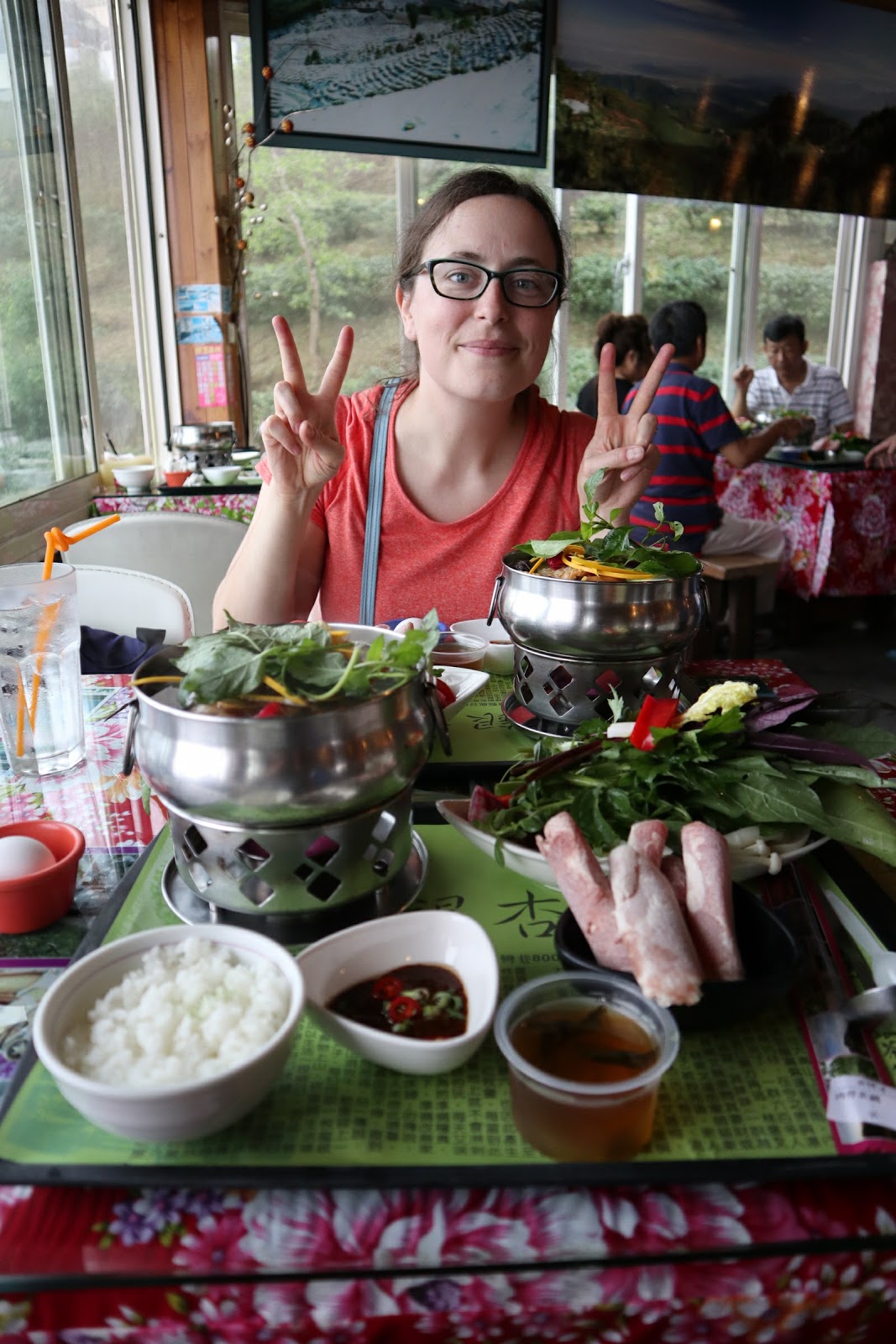
After we bought several packages of our favorites from among the teas we sampled, they sent us on our way up the mountain to the nearby 杉林渓 tea growing region, where they also had their farm. (I really wish I knew how to pronounce 杉林渓, but I don’t. It was like that for the whole trip: I knew the characters and their meanings, but not how to say them.) We had a beautiful hotpot with a wide variety of local vegetables for lunch.

Hotpot: a little bit of lamb and a lot of vegetables
High mountain tea farm!

Words (and pictures) don’t do justice to the delight of this experience, or to the regret I felt that we likely won’t meet these lovely people again. But I think I now know more fully the meaning of 一期一会 (ichi go ichi e): treasures of time to be enjoyed with thankfulness.