Showing posts with label Missionary life and work. Show all posts

Wednesday, February 26, 2020

Carols, Candles, and Cookies

Today's coffee: Tokumitsu Costa Rica full city roast

To catch you up, if we haven't talked in a while, Keith and I now work at COEN Life, among various other commitments. Now that we are through our initial transition period, I am finding that I have more time to write, and more to write about, so here's hoping for more blog posts in the near future! Here is a story from Christmas Eve last year.

“Why don’t you come to one of our Christmas events?” Keith handed a flier to a regular café customer. She sneered at it. “I’m not a Christian.” Keith related this exchange to Dale, our boss, later; he shook his head. “I don’t think we can expect many people to come.” Suddenly the hundreds of fliers we had printed seemed like overkill.

The sneered-at flier
It’s hard to get anyone to attend an openly religious event. We knew this. Many churches and Christian groups solve this problem by advertising a concert or other non-religious event, then, when the captive audience has been assembled, preaching an evangelistic sermon. It has not been our strategy at COEN Life to preach to captive audiences, but rather to pray and respond to opportunities when they arise.

For Christmas Eve, I put together a Lessons and Carols service with well-known Christmas carols and readings from the beautifully translated Japanese edition of the Jesus Storybook Bible. I also designed the aforementioned sneered-at fliers; I think they were rather nice looking, but they honestly let the guests know that they were in for something religious.

Christmas Eve fell on a Tuesday, a busy day at the café. We hoped that people would stick around for the Christmas Eve service, but maybe it would just be us. Maybe it would have been better to do “candle service,” as it’s called in Japanese, on a different day, we fretted, since Japanese people likely want to spend Christmas Eve with their families or their lovers, not at a religious event. Still, we pushed the three big tables together and began to set up. Karen fitted the candles in their holders. Keith checked to make sure he had all ten songs marked in his hymnbook. Hiromi, tasked with reading the stories, made a few last minute edits to her manuscript. I sang through the archaic Japanese translation of the carol I would sing solo. I confirmed with Dale and Karen when I wanted lights and candles lit and extinguished for dramatic (and theological) effect.

A few minutes before the café closed, Hiromi and I took our places at the head of the table, Karen sat by the advent wreath, and Keith at the piano. A few café guests lingered at the table, while others headed home. Then, to our surprise, people started coming in. A few had gone home after their English classes but had decided to come back! The seats around table started to fill up. Eighteen people, nineteen… I started the service with greetings and an explanation of the Lessons and Carols tradition. Then the twentieth person came in and took the last seat at the table. I prayed for God to reveal himself to us in the telling of his story.

We sang “O Come, All Ye Faithful.” Dale turned off the lights, and a hush came over the room as Hiromi began to read the creation story. A world came into being in our minds in the darkened room. We alternated carols and stories, with the prelude from Bach’s 3rd cello suite and my debut at accompanying my own singing on the ukulele thrown in.

Karen lit the Christ candle as Hiromi read the story of Jesus’ birth. At the end of the service, Karen lit her own candle from the Christ candle and we passed the light around from one person to the next, until each person held a burning candle—powerful symbolism of the power of God to change lives and turn darkness into light as each person welcomes his presence in their lives.

After the service, as we feasted on Christmas cookies and hot apple cider, I talked to some of Hiromi’s English students. “I could see the story happening,” said one of them. “It was beautiful—and it was so real.”

I have learned not to judge the success of an event by how many people come, but rather by whether those attending have become more interested, more curious, a little closer. A person who has been given something beautiful, and who feels loved and accepted, will certainly remember, even if they don’t come back.

Want to read another story from our work at COEN? I wrote one for the OMF Japan blog.

Wednesday, January 08, 2020

The Fragrance of Daikon

It was evening, and a light dusting of snow coated the front walk. Eager to be home, I opened the outer genkan door… and was hit with a wave of intense smell. Surprised, I looked around. A bag of plastic recycling that didn't get collected over the New Year holiday sat waiting on the floor--surely plastic hadn’t started to stink? But what else could there be? That’s when I saw a bedraggled plastic bag containing a shriveled daikon pickle balanced on the gardening cabinet, presumably an offering (or a prank?) from one of our neighbors. Keith followed me into the genkan. I pointed to the pickle. "Wow," he commented, wrinkling his nose.

Confident as we were that daikon pickles are supposed to stink, and trusting our neighbors’ pickle-making ability, we immediately brought it into the kitchen, cut up a bit of it and arranged it with a tea egg on top of our traditional January 7 okayu porridge. It was delicious.

We took the precaution of double wrapping the rest of the pickle before putting it away. And now there’s a bag of concentrated fart in our refrigerator.


Wednesday, January 30, 2019

Where I Belong

Today’s coffee: Valentine’s blend (but I’m still drinking New Year’s blend at home)

It seems like ages since New Year’s Day, and at the same time, it seems like no time has passed at all, as if I were just opening my jū-bako to show off this year’s osechi to Keith. But since it is still January, Happy New Year! 今年も宜しくお願い致します (Please be kind to me this year too.)


Osechi, the traditional Japanese New Year’s feast, is the most complicated and labor-intensive meal of the year. I spend a day planning, half a day shopping, two or three days cooking, and then about two hours arranging the food in a three-tiered lacquered box (jū-bako). There’s a word in Japanese describing an undertaking like this one: 面倒くさい (mendō-kusai), which literally means “stinks of trouble.” The benefit of all this work is that we eat it for days. Traditionally it’s three days, but with only two of us, it lasts at least a week, until we’ve had enough, but it’s still not gone. “Maybe you should make smaller batches next time,” suggested Keith.

Filling the boxes...
Step by step, as each item goes in
This year included, I’ve made the full-on osechi meal six times. The first time, in 2010, I could barely read Japanese; I was saved by the step-by-step instructions with pictures in my osechi cookbook. Some of the ingredients and cooking techniques didn’t even show up in my dictionary, so a lot of guesswork was involved. This year I didn’t use a dictionary at all, since my cooking obsession gave me the motivation to learn all that complicated vocabulary and more. Keith says our osechi gets better every year with practice, but he’s probably also getting accustomed to the taste.

As I made grocery lists and translated recipes and shopped for expensive ingredients this year, part of me wondered why on earth I put myself through this rigmarole (almost) every year. It’s tasty, but perhaps not three-days-of-solid-work tasty. Hardly any of my Japanese friends even do this; if they eat osechi (it’s kind of old-fashioned), they order it from a department store or restaurant. So why?

I suppose it’s the same reason I eat turkey and all the fixings on Thanksgiving Day, despite it not being a holiday here, and despite the trouble and expense of getting all those imported ingredients. It’s because back home, all my family and friends are eating turkey and sharing around the table what they are thankful for. When I eat the same meal and give thanks with my friends here, even in Japan, it’s like I’m affirming that even with the ocean dividing us, I still belong to my family and to the community in which I grew up.

By making and eating Toshi-koshi soba (year-crossing soba) on New Year’s Eve, osechi and ozōni (soup with mochi) on New Year’s Day, nanakusa-gayu (seven-greens rice porridge) on January 7, and so on, I remind myself that I belong here too, to this place and to these people.

Each of the foods in the osechi feast symbolize a hope for the coming year: red and white foods expressing the festivity of a fresh start, tiny fish for fruitfulness, beans for the ability to work hard (a wordplay in Japanese), kombu rolls for joy (also a wordplay), lotus root (which has holes) for clear-sightedness, taro root cut into turtle shape for longevity, yellow foods for prosperity, and so on. I eat these foods together with my friends here as I share their same hopes and prayers.


This is comforting, when so often I feel out of place and out of my depth, and sometimes I don’t even want to belong. But God brought me here and joined me to this community also; I affirm this by my feasting.

It’s no wonder, since I also experience my deepest belonging by feasting at the Table of Tables—and this sense of belonging informs and deepens the others as heaven and earth are joined together. I belong here and everywhere God is honored.

Monday, May 07, 2018

Beautiful Scars

I like going to the beach. Not so much for the swimming, although I like doing that too, when the weather is right and the conditions are good. (Definitely not for sunbathing.) I think my favorite beach activity is looking at stuff and picking stuff up. My senses become so attuned to finding beauty in the tiny objects mixed in with the sand that I can only think of those things, or perhaps the things they remind me of.

We are at the beach this week, not on vacation, but to have time without distractions to reflect and write and prepare for our home assignment this summer.


Beautiful scenery and fresh air and exercise are aids to creativity, so I went out for a walk this morning between essays. Last time we came here, I was drawn to smooth rocks and moon-snail shells. This time, I have been collecting beach glass.

Beach glass is often used as a metaphor for the process of maturing through adversity: continually tossed by waves with sand and salt, the sharp edges are worn down.

I couldn’t help but remember, though, my Dad’s warning to me when I got my first camera: never let your camera come into contact with sand. The sand will scratch the lens, and it then the camera will be worthless.

The beautiful opaque surface of beach glass is actually made up of scratches and scars that will never “heal.” Until the glass is recycled, those scars will remain. These shards are indeed worthless for their original purpose, but not ultimately worthless: re-purposed, they could become something far more sublime than a beer bottle.


As I look back over these last two years, I’ve struggled to remember the encouraging things that happened, and even more so things that will be meaningful to anyone other than me. But this walk on the beach has made me hopeful that eventually I will see some beauty and purpose even in my own brokenness… maybe even this week as I write!

How will God use my scars to show his glory? I’m looking forward to finding out.

Which brings me to an important announcement:
Mid-June through mid-August we will be in North America on a short home assignment, based in Seattle. We are in the process of working out our schedule, so we will have more details soon. We’re looking forward to seeing many of you this summer, and sharing the stories we’re writing this week!

Wednesday, August 23, 2017

The cup is half empty


Today’s coffee: Indonesian coffee from Tokumitsu

I did everything I could. A day off every week, life-giving hobbies, daily quiet-times, plenty of sleep, four weeks of vacation each year. We had people looking out for us, both colleagues and friends. And yet, it seems that even our careful precautions weren’t enough. Eight months into working in our church in an emergency state, I burned out.

Back in college, only once, I drank enough to have a hangover. Only once. Once was more than enough. On the bright side, I can now say with personal conviction, when talking to young people, that drinking too much is not only inadvisable, but the effects are downright unpleasant.

I bring this up now because the effects of burnout are very much like a hangover-that-doesn’t-go-away. Let’s call it a stress-hangover. Headache, queasy stomach, lethargy, brain in a fog. Back in college, the day I had a hangover, I aced a German test. Now, with stress-hangover at age 36, I’m not good for much of anything that resembles work, except perhaps a snarky blog post. Writing helps me process, after all. Even being able to snark about things is a decided improvement over where I was a week ago.

On the bright side, I can now say with personal conviction that working too much, especially in a stressful environment, is not only inadvisable, but the effects are downright unpleasant. Cheers for coffee, my caring husband, and colleagues who give me space to sleep it off and help us find a more sustainable pattern of work.

Note for the concerned: We are well cared for here. This was no one’s fault. We continue under the strong conviction that we are where God wants us, and we continue to look for the way forward in this situation.

Tuesday, November 29, 2016

November Newsletter

Seasons
Keith and Celia Olson
Newsletter #34
November 30, 2016

Newly completed bar counter at Matsu House!
Dear Friends and Family,

Greetings from snow-covered Ishikari. The snow came early this year, and we are still trying to prepare our garden and house for winter. Keith has been busy plastic-wrapping windows to conserve energy and researching the least-stinky kerosene heater for use in our bedroom. We hope to get the first floor rooms completed in time for welcoming friends for Christmas meals and other holiday gatherings.

Meanwhile, Celia has been practicing the fourth Bach cello suite for her Christmas Day concert at Wakaba Church. Sambi Reihai (our informal afternoon worship service with music and scripture readings) stopped while we were on home assignment, but we hope that this Christmas “concert,” which will involve participation from many church members and include some of the same elements as Sambi Reihai, will be a step towards getting it started again.
***

Prayer Points
  • Christmas events at Wakaba include women’s Christmas tea (Dec 3), children’s Christmas party (Dec 11), Celia’s small group Christmas tea (Dec 17), youth Christmas party (Dec 23), Christmas Eve worship, and Christmas Day worship, lunch and Celia’s concert. Please pray for those who will invite friends and family. Please pray also for us, as we hope to have friends over for meals; pray for wisdom for whom to invite and when.
  • Please pray for first floor house reforms to be done in time for Christmas hospitality.
  • Keith’s small group is hoping to start “Kodomo no shokudo,” a ministry in which they hope to occasionally provide supper for children in our community whose parents work late. Please pray for a clear vision for how to get started and what they hope to accomplish.
  • Please pray for more energy. We have been feeling tired and unproductive, which is discouraging. Please pray for us to depend on God’s strength, not our own, and to get enough rest.
  • A number of our friends are facing serious health issues. In particular, please pray for David Ferguson (OMF Japan field director, blood cancer), SL (our close friend and OMF colleague, recently diagnosed with type 1 diabetes), and KS (Wakaba church member, cancer).
  • Please pray for our ongoing preparations for teaching at HBI (Keith) and arts ministry (Celia). Please also pray for Keith’s safe travel to and from HBI classes (in winter, the trip takes about an hour each way on icy roads).
***

Decisions, Decisions
In the process of discussing our second term ministry with our pastor and with OMF leadership in September and October, we discovered that it would be impossible to continue in all the ministries we were involved in during our first term. We therefore decided that we would continue training small group leaders (and take part in each of our groups’ activities), preaching (mostly Keith), and worship leading. Celia plans to start a small Bible study group for the benefit of a new Christian, with hopes that the members of this group will become more confident in their faith and that perhaps they would be able to lead Bible studies with seekers in the future. Keith has started auditing classes at Hokkaido Bible Institute (HBI), where he will teach, and Celia is in the visioning stage for her new arts ministry. Thus we decided to step back from youth ministry for the time being, since we already had many other things on our plate.
***

Preparing to Teach at Hokkaido Bible Institute
I (Keith) have been studying Japanese for 7 years, and some of my well-meaning Japanese friends have hinted that my Japanese level must be somewhere around a 7-year-old’s. Using this logic, when I turn 8 in Japanese next year, I will start teaching Isaiah to graduate level students. Now imagine a third grader walk to the front of a class of pastors in training, call everyone to order, and open his briefcase to take out his class notes. Give that third grader a beard and tweed jacket, and that is not entirely unlike the position in which I imagine myself to be in one year’s time.

Keith's first day auditing classes at HBI
As intimidating as it feels to teach Isaiah in Japanese, I am equally excited to see how God has been equipping me for it, and likewise, excited to see how this next year will unfold as I brush up my Hebrew and Greek (among other things) by taking classes at HBI. Since coming to Japan, reading the Bible with Japanese people has always been one of my greatest joys. This passion is perhaps the main way God has guided me to this position at HBI.

As I look back on my life before Japan, another piece that has fallen into place is my desire to teach. In college, I took several teaching classes (before I escaped via music degree); I’ve enjoyed many teaching assistant positions and tutoring jobs along the way; and during seminary I even started to pursue various Bible teaching positions at private schools. I have found that if I really want to own what I have learned for myself, I must teach it, and even while teaching, I learn with the students and come to a deeper understanding. Basically, I teach in order to be a better learner.

And finally, a passion I have that connects a core value of OMF with HBI, is to see churches planted in areas where there is no church, especially in towns and cities of rural Japan. During our camping vacation in September, Celia and I experienced first hand what it is like to attend church in rural Japan. After much searching, we found that the closest church to our campground was over an hour away by car in Bihoro, and we passed several towns to get there. The closest town, Teshikaga (population 8,680), had a church a number of years ago, but it since closed.

Even now, our friends at the church plant in Nayoro (population 30,920), where I preached and Celia played a concert in 2014, have been waiting several years for a full-time Japanese pastor or evangelist to partner with them. At the same time, churches without pastors are increasing as the church, with the rest of Japan, ages. In order to see more church plants, we need to see more pastors trained to fill the vacuum of pastorless churches and unchurched towns, and to fulfill the role of the Japanese church in global missions in those ways in which the Japanese church is uniquely gifted.
***

HBI Quick Facts
  • Started in 1964.
  • Has a three-pronged approach to Bible training: study, life, and service, which is reflected in their motto, which, roughly translated is "Know Christ in order to serve the church, the world, and this generation." (Sounds cooler in Japanese.)
  • Has around 15 full time students as well as other attendees. Right now, we are praying for 5 new students to start next year in April. 
  • Offers a 1 year “Believer’s Course” and a 3 year Pastor’s degree.
  • If you are interested in supporting the work of HBI, please use this link.
***

Matsu House Update
Thanks for praying! Since the last newsletter, Keith finished painting both sides of the bedroom and build bookshelves in the “hallway” between. He also painted part of the roof to enable snow to slide off. Mr. Inoue (Shino’s dad) completed the bar counter in the kitchen, which Keith coated with finish. Mr. Inoue and Keith then moved on the the next big project: the dining room. Keith stripped the wallpaper, put additional insulation in the floor, enlarged the doorway to the kitchen, and painted the trim, while Mr. Inoue installed wood flooring. They are currently in the middle of applying keisodo (a traditional plaster used for tea rooms) on the walls.

Keith models his new bookshelf (and tweed jacket).

Installing the last strip of flooring in the dining room

First dinner party in the dining room! (Walls yet to be plastered...)
We have discovered that a house that needs work improves our relationship with guys of our acquaintance, since many of them are eager to help us out and work together with Keith. We’re very thankful for helpful friends. Please continue to pray with us as we continue to work towards a home in which we can show God’s love through hospitality.
***

Enjoying Hokkaido Autumn
Remember Mr. and Mrs. K who were baptized last year? Guess what? Mr. K is a hiker! God brought us a hiking friend!

Mr. K is in the center, between Keith and Celia. Behind him is Noriko. The others are co-workers and friends.
We also went on an onsen expedition in early November. Thankful for new friends!

Mrs. K is next to Celia. In the background are Noriko, Miki (Takakashi-sensei's daughter) and Mina (Takahashi-sensei's wife)
***

Language Corner
The owner of our house left us two tiny electric heaters, which heat tiny spaces in our house through the Hokkaido winter. They came with the added benefit of interesting English.


The box reads: “Mini Fan said, ‘I will give you a petit hot, and clean air.’” Thanks, Mini Fan.

The fan itself also promises that it's a "clean pet" and it includes "air remover." Oh my.
***

Thanks for praying! May God bless you with his presence this Advent.

Love in Christ,
Keith and Celia

Remember me? I'm the grapefruit tree. I'm glad to be in my new home, and not outside... it's cold out there! (I had a haircut.)

Tuesday, September 27, 2016

Weeding

Today’s coffee… I mean tea: some really old tea that spent a year in storage. Waste not, want not…

This month, we’ve been focusing on catching up on various things and doing house projects. The bar counter is finished!! Half of the painting in the bedroom is finished, and Keith is currently putting the second coat on the other side. In just a few days we will be able to move some furniture that goes in the other half of the bedroom out of the dining room, so maybe we can start work there next… replacing rotten tatami with wood floor and flaking wallpaper with the traditional plaster wall that tea rooms have! One step at a time… there are many other projects too.

This is the talented Mr. Inoue who built the bar counter and helped us and advised us in many other ways.
All done!!
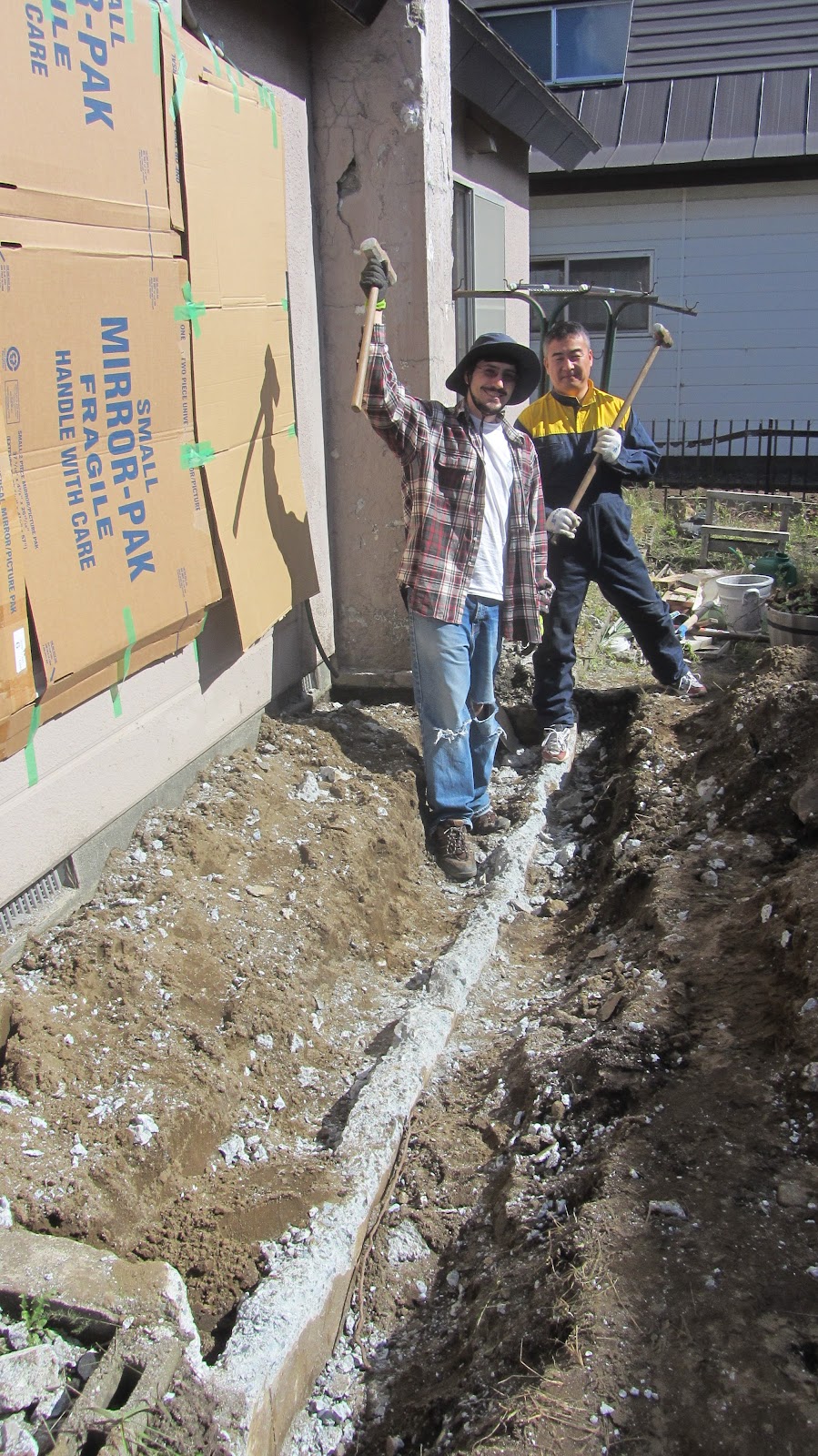
We’ve also been enjoying lovely early-fall weather by working in the garden. Keith invited a friend from church for a “concrete party” to break up a slab of concrete that was unfortunately slanted towards the house. He used some of the broken concrete chunks to make a path, where before there was only weeds and mud.

Concrete-bashing relieves stress.

I have spent most of my outdoor hours weeding. Although we have been somewhat successful removing weeds from the front of the garden, the back of the garden, where there are a lot of trees and shrubs, has been a challenge… untangling the roots of persistent weeds from the roots of plants we actually want growing there.

I thought at first that the bamboo grass would be the hardest weed to get rid of, but now I don’t think so any more. Our entire garden is infested with dokudami (Houttuynia cordata, which is sometimes known as chameleon plant in English). When we started digging beneath the surface to pull them out, we discovered an thick web of roots. “It looks like medusa down there,” Keith commented. Leave even a tiny bit of dokudami root in the soil, and it will grow right back.

Dokudami roots growing through a random block of styrofoam we found buried in our garden
But the funny thing is, dokudami isn’t really a weed. It’s a very pretty plant, with deep green heart-shaped leaves tinged with red, with lovely cross-shaped white flowers in July. It’s also an herb, prized as a detox-tea in China and Japan. I heard recently that if you rub the leaves on a mosquito bite, the itching goes away. Dokudami also keeps your compost from stinking… but we’ve found that the composting process doesn’t kill the roots… yikes.

See all those cute white flowers? That's them...
In the hours and hours I’ve spent carefully removing dokudami and bamboo grass roots from my around rhododendrons, I started to think of weeding dokudami as very similar to what is going on in my life right now. I have two jobs--I work at Wakaba Church, and I am also a musician with dreams of starting an arts ministry. There are many very worthy tasks and ministries and causes that I could be spending my time on, but if I tried to do everything, I think I would burn out very quickly. I need to make space in my life for the most important things--the things God has specifically given me to do. It’s just difficult sometimes to discern what those things are. Which “weeds” (which are actually very nice plants) in my life do I need to say “no” to in order to make room for other “plants”?

Please pray with us… we have some big decisions to make… and we need to make them soon!

Sunday, August 07, 2016

Learning to Wait

Today’s coffee: “Hana” blend--that’s the signature blend at the new Tokumitsu shop (right next to church!! First visit!!)


It’s Monday, but I needed to get out of the house. Right now all the parts of our old kitchen are sitting out on the sidewalk. Meanwhile, three guys are busy in the kitchen replacing the insulation and messing with the pipes and wiring. Tonight there will be no kitchen, so we will eat leftovers out of the fridge, which thankfully didn’t need to be moved out of the kitchen.

Out of focus, but here's what things looked like this morning.
When we came home from class, this was in progress. We learned that Japanese houses are built quite differently than American ones. (Keeping the awesome 1970's lamp.)
Also, the bedroom is still in process. Keith is busy making preparations to paint… still. It’s been quite the task ripping down the wallpaper. The only other place I could retreat to is the “tea room” where we are currently sleeping, and which is hot as a sauna, since we thought it might rain, and thus closed the windows before we left for class this morning.

It hasn’t rained yet, but it needs to. Not that we are hurting for water, but the air is hazy and kind of stinks like it did a few years ago when there were forest fires on a neighboring island. Rain would be nice, to wash away the haze and maybe cool things off a bit.

A few weeks ago in class, I wrote a poem about waiting for rain. As I wrote, I recalled last summer in Seattle, when haze and stink from the seemingly endless fires in eastern Washington drifted west into the city. We waited and waited, but the rain didn’t come. And yet, at the same time, we knew that in Seattle, there would be no autumn without rain.

My poem, however, didn’t work very well in its original form. The idea of waiting for rain in the summer seemed obvious to one such as myself, having experienced many US west coast summer droughts. In Japan, summer means rain, but that rain doesn’t always bring relief from the heat. “It’s already hot, and you want it to get humid too?” a Japanese reader might think.

Thankfully, my teacher suggested a very descriptive word (炎天下 entenka) which fit both the necessary syllable count and the feeling I was trying to get. It literally means “under the burning sun.” Here are the first and second drafts, for those of you who can read Japanese. Let me know what you think. I’ve had some suggestions from another poetry-writing friend, so I will probably make some more changes later.

Draft 1:
浮雲が (Ukigumo ga)
空飾るのに (Sora kazaru no ni)
空頼み (Soradanomi)
心、かさかさ (Kokoro, kasakasa)
雨、いつ降るの?(Ame, itsu furu no?)
(A floating cloud decorates the sky, but it’s a fleeting hope. My heart is dry. I wonder when it will rain?)

Draft 2:
炎天下 (Entenka)
心かさかさ (Kokoro kasakasa)
空頼み (Soradanomi)
浮き雲ひとつ (Ukikumo hitotsu)
雨、いつ降るの?(Ame, itsu furu no?)
(Under the blazing sun, my heart is dry--fleeting hope. There’s a single floating cloud; I wonder when it will rain?)

I think perhaps the second version expresses more hope than the first. I probably felt better after talking through the poem with my teacher, so perhaps that’s why it ended up that way.

I’ve written lots of poems about perseverance and waiting. It would be nice if it rained today, but more than rain, we’ve been waiting for the new kitchen to go in so we can unpack… so we can cook… so we can start inviting people over to eat with us. We’re waiting for a lot of other stuff too. I’m learning (not always gracefully) to be content with where I am while at the same time not giving up on eventually getting to where I want to be.

Friday, April 29, 2016

Introducing the OMF Blog, and my Q&A post

Today's coffee: Kauai Coffee, Poipu Estate (Just a few more weeks, and I'll be back at Tokumitsu!! And great news: they've opened up a new shop, right next to our church. Praise God...)

Not much blogging going on around here. I've been writing a lot, but mostly my own personal thoughts as I sort out some stuff about going back to Japan--mostly about where we're going to live. Nothing blog-worthy (yet).

One recent "writing assignment" was a Q&A for the OMF blog about arts ministry in Japan. It was helpful to write this, because I was able to summarize my past ministry, my hopes for future ministry, and also opportunities to serve and pray in a pretty concise format. I'll probably post the whole article here later, but for now, I'd love to advertise the OMF blog, so go read it there! The focus this month is Japan, so you may find other articles that interest you from my colleagues.

While we're at it, I also recommend this article on the OMF blog about the importance of theological education in Asia. Our friend and colleague, Dr. How Chuang Chua is quoted, and HBI, where Keith will be teaching (and where How Chuang taught until his death), is also mentioned. 

Friday, February 26, 2016

February Newsletter

Dear Friends and Family,

We are excited to announce that we have been designated! For those of you who don’t understand OMF-language, that means we have been officially assigned to a church and a job in Japan. We will be back at Wakaba Church, and also doing ministry elsewhere: Keith will teach new pastors at Hokkaido Bible Institute and Celia will start a music and arts ministry. We have each written more about our vision for ministry below.

In other exciting news, Shino Inoue, Celia’s friend and pianist, is coming to Seattle! Celia and Shino will present concerts on March 5 and 6, giving our supporters here a chance to meet one of our ministry colleagues and experience our music ministry firsthand. Celia is also planning to release an album of music from our first term, titled Music and Stories, concurrently with the concert. Please let us know if you would like one!

Celia's new album
Thank you for praying for our travels and family times over the last few months. We were able to spend Thanksgiving with Keith’s family--we met 2 new nieces for the first time and caught up with all the rest of the nieces and nephews too! Then we spent Christmas with Celia’s family for the first time since 2007. The next day we were off for 6 days in St. Louis at the Urbana student missions conference where we talked about missions and OMF and Japan with lots of college students who stopped by the OMF booth.

With our oldest niece/goddaughter, Elizabeth
Urbana.
Back in Seattle, two New Year feasts, mochitsuki party… and then the last of the exciting news: our nephew was born January 7, the first on Celia’s side of the family: Calvin Chen Wilson! We got to visit him when he was only a few hours old.

Calvin!
***

Prayer Points

  • We are thankful that our designation is finalized! Please pray for us as we begin to think about how to balance our responsibilities between church and other ministry. 
  • Please pray for Keith’s classes at Regent College (major paper due March 4) and his preparations to teach at Hokkaido Bible Institute. Teaching theological concepts in Japanese will entail a steep learning curve. 
  • Please pray for Celia and Shino’s concerts, March 5 and 6. Shino arrives February 29. Please pray for effective rehearsals (we only have 5 days!), encouraging time together, good health, and that our concerts will be a blessing to those attending.
  • Please pray for our meetings with individual supporters and for 100% pledged support by our deadline on March 23 (we are currently at 92%).
  • Keith will be visiting his family March 18-26. Please pray for a good time together.
  • Please pray for the students we talked to at Urbana as they take their next steps towards missions involvement. Please also pray for our OMF US colleagues as they continue with follow-up.

***

Tea Bowl: We have 92%!

We’re coming up on our deadline: one month left! We need 100% pledged monthly support for our second term. If you plan to continue your support from our first term into our second term, thank you! If you haven’t told us yet, please be sure to let us know again in person, by email, or through the OMF website  (select “update information,” and enter “re-pledging” in the comments). Our deadline for 100% pledged monthly support is March 23, 2016.
***

Celia’s Vision: A Restful Space

The contents of my arts thesis box at the library
A few weeks ago, I was sitting in the Regent College Library in Vancouver. Keith was busy studying for one of his classes (he’s taking classes to prepare for his new ministry); I was with him for MissionsFest and a concert. I glanced up and saw a sign for the arts thesis (IPIAT) projects on a nearby bookshelf; I went and found mine: Praise the LORD with Stringed Instruments: Instrumental Music as Participation and Contemplation. Although I once had had great ambitions of continuing my project and maybe turning it into a blog or a book, it had been years since I even looked at it. (Japan happened. Surprise!)

I felt nostalgic, looking through the pictures, programs, CDs and other items in the box—even a paper star from the prayer-origami I had everyone do. I thought back to all the people who collaborated with me on this project and all the work that went into it. But until I opened the 3-ring binder containing my thesis, I couldn’t remember what I had written.

I thought I had given up on this project when I went to Japan. But it turns out, the things I studied, agonized over, wrote about, and put into practice back in the 2008-2009 academic year were still swirling around in my head as I agonized over the rut into which I had fallen with the bait-and-switch-style concert ministry that was expected of me in Japan. (Come to a concert! You’re also going to hear a sermon, but I’m not going to tell you that.) Here are a few highlights from my thesis:
“Words, even edifying and truthful words, can be busy and noisy. They crowd the airwaves and our brainwaves. We need the wordless space that can be offered by instrumental music, time to listen quietly, waiting to hear a still, small voice.” 
“I am aware that I need more than anything to pray, to listen, and to be still before God. Studying theology is like drinking from a fire hose.” So is Japanese study and missionary work. “There is so much to learn in such a short time that reflecting on what I have learned is an unknown luxury. The feedback I received after the first three worship services [the practical component of my project] convinced me that I was not alone; we all need to gather deliberately to be silent before God.” 
“Even though this stage of my project is complete, I consider it only a foundation for work that will last the rest of my life. The stillness and rest offered by instrumental music is a great need. Wherever I go, I will continue to offer this restful place to those around me.”
Reading my thesis again, I am encouraged that it’s okay to re-think my music ministry, because the quiet space I want to offer is necessary to the souls of over-worked businessmen and women, students, pastors, and missionaries. Busy people forget about God—or they don’t think about him in the first place. Therefore, providing quiet space for contemplation is a vital part of evangelism.

Our designation is finalized: we’re going back to the Sapporo area, to Wakaba Church in Ishikari. As for me, I’ve been given a blank slate to start a new arts ministry. Now is the time to pick up that dream of offering a restful place to those around me: a collaborative arts ministry involving my own disciplines of music and tea ceremony as well as the gifts brought by like-minded colleagues. What will this look like practically? Who knows? What I do know is that it will start slowly: 一歩一歩 (ippo ippo)—one step at a time.

I surrendered my dreams at the foot of the cross… and now I’m picking them up again. Wow. This is really happening. I’m so incredibly thankful.
***

Keith’s Vision: God Gives the Growth 

Blast from the past: Keith studies in the Regent library for his comprehensive exams in April 2009
While I was taking classes at Regent College 10 years ago, I struggled with my vocation. I had no idea where or what God had in store for me, but one option I seriously considered was teaching at a Christian school, and I knew how I would do it. I imagined myself teaching students, who were struggling with the Bible like I had, all the exegetical tidbits I wished I'd known.  I even looked at job possibilities in California. Fortunately, God brought us to Japan instead, and like Celia with her thesis, I shelved my idea of teaching.

10 years later, I am taking a couple of classes back at Regent College, again struggling with my vocation. This time I know where (Hokkaido Bible Institute) and more or less what (teaching exegesis, Isaiah, and perhaps more), but I'm not exactly sure how.  As I commute from Seattle to Vancouver, I often wonder how to contextualize what I am learning for a Japanese school. The classes I'm taking have already gone a long way to recondition my theological muscles, but reconciling the critical English approach with the top-down Japanese teaching style is impossible. Not that I think teaching Bible in any context would be easy, but like the times I preached, led discussions, held events, or even any time I answered the phone, if I have any success in Japanese, it is only by God's grace and his enabling.

I originally intended to write about the problem of aging pastors and the rise of pastorless churches and to discuss the need for the younger generation of Japanese Christians to step into full time ministry positions. And I do trust that I will be able to support HBI in its mission to train pastors, evangelists, and lay leaders, but I don’t see my ministry as filling a need as much as being filled myself.  I have mentioned not in so many words before, but I go to Japan for a very personal reason: to grow closer to God. I do long to see Japan grow closer to God too, and in some inexplicable way, God has shown me that my life and the life of Japanese people I encounter are bound together. I grow with them; I don't grow them. When I think of the times I’ve opened the word of God with Japanese people, I both witness and am witnessed to at the same time.

This is a long way of saying that although I am intimidated and humbled, I am excited to have the opportunity to share life with pastors, evangelists, and lay leaders, and to grow with them in any way that God gives growth.
***

Only three months left until we return to Japan--May 23! Let us know if you want to meet up before we go back. Thanks for your continued prayers.

Love in Christ,
Keith and Celia

Sunday, January 17, 2016

Forgiving Myself for Being an Introvert

Today’s coffee: Tully’s

If you read our blog and follow our lives, you will probably know that we went to Urbana last month. It was this completely wild event—16,000 Christian college students and pastors and missionaries gathered together for worship, Bible study, prayer, networking… and if I had wanted to, I could have been at workshops and seminars and gatherings and whatnot from 7 a.m. until past midnight.

Keith and I were approached by our leaders to represent OMF Japan at Urbana, since at past Urbana conferences, there has been a lot of interest in Japan. I waffled as to whether I wanted to go, or whether we should go. 16,000 people… long hours of meeting total strangers… awkward social situations… very little time to rest. But, Urbana got a rave review from my brother and others who had gone. They spoke of challenging messages and spiritual growth. What ultimately tipped the scale in favor of my going was the discovery that Jeff, one of our IVCF leaders from grad school in Boston, was going to be there. (And out of 16,000 people, we ran into him right at the front door. Awesome!)

But as the time grew nearer, I got more and more nervous. “God, I can’t do this. Please make me an extrovert,” I prayed.

This wasn’t just my plea for Urbana. It seemed that the longer I spent in North America, the more exhausted I got… and I was beginning to think that there was something seriously wrong with me. I had been spending delightful, thought-provoking, inspiring times with friends, family, and supporters. I was constantly aware of how loved I was and how well supported, and perhaps that made the feeling that I “wasn’t getting anything done” even more frustrating—that I was letting down the people who loved and supported me. The sheer amount of rest I needed to recover from the previously mentioned delightful times with people seemed far more than what was “fair.”

It was at Urbana, in a moment of quiet respite from the OMF booth, where I had been meeting students and answering questions about OMF and Japan, that I was browsing the bookstore. A title caught my eye: The Listening Life by Adam McHugh. What I found even more intriguing was that this Adam McHugh was also author of a book called Introverts in the Church. So, I went looking for Introverts in the Church and found it elsewhere in the bookstore. Hiding in my room after dinner that night, I read the first chapter… it was like he had been reading my thoughts. Observe:
For several years, my introverted friend, Emily participated in a Christian community where extroversion was normal. Hailing from Japan, Emily was accustomed to a culture where deference to others and servanthood were considered highly desirable qualities, and she felt displaced in an American culture that valued self-promotion and aggressiveness. She had positive relationships with people in the community, but she was always considered to be on the fringe because she spent a lot of time to herself (McHugh, Introverts in the Church, 17-18).
And the lightbulb came on in my head. That’s what it is. That’s the source of my exhaustion and reverse culture shock this time around. I had been thriving in life and ministry in Japan, where introverted characteristics are valued, and deep, loyal friendships are formed slowly over time and through shared experiences. Social interactions tend to have more silent spaces in them, and that’s okay—just being together or doing something together is considered to be a valuable experience. I’ve written about this before, but I didn’t realize at the time why I felt so comfortable with my Japanese friends.

Then I came “home” to my hometown, where I thought I would be less tired, since I was using my native language. But I struggled with American-style social interactions, where there is little silence in which to collect my thoughts—if I stop to think, the conversation has already moved on. To make things even more difficult, of course we are dealing with an absence of four years. It’s not easy to catch up with each of the hundreds of friends and acquaintances we left behind when we went to Japan. There have also been faux pas, such as
Me: Nice to see you!
Acquaintance: Yeah, it’s been a long time. Were you really gone for four years?
Me: Yeah, four years. It seemed really fast though. How’s your husband?
Acquaintance: Actually, he left me…
Me: (gasp) I’m so sorry, I didn’t hear!
I really had that conversation. Stress.

I certainly don’t mean to imply that Japan is good and America is bad, or that all Japanese are introverts and all Americans are extroverts. That is not the case at all… not to mention that I have committed my fair share of faux pas in Japan.

But I have to say that in recognizing this cultural difference, I have also recognized God’s grace in putting me in a place where I would thrive in friendship and in ministry. I have begun to realize that God made me the way he did so that I could be a blessing to others. It wasn't a mistake. No more pleading for a personality change... just a change of heart.

While I am eager to return to my friends and work in Japan, I am also eager to accept God’s grace where I am now, even, or perhaps especially, when God’s grace means spending more time in prayer and reflection and less time “getting stuff done.” I trust that God will give me the grace (and the energy) to bless my friends here in North America and be blessed by them as well.

I still have times when I am frustratingly exhausted, but I think my prayer now is “God, thank you for making me the way you did. May my life bring glory to you.”

I went back to the bookstore the next day to buy The Listening Life too. Thanks, Adam McHugh, unmet friend.

(By the way, Introverts in the Church is not a whiny book about how we introverts are being exploited by extroverts. Not at all. I wouldn’t have liked it if that were the case. I found it to be empowering, practical, and filled with great suggestions for introverts to be involved in the life of the church. Perhaps that is a subject for another post.)

Friday, January 01, 2016

Urbana and New Year's (and monkeys)

Today’s coffee: some beans my mom got for Christmas

Happy New Year! It’s the year of the monkey, or it is in Japan, anyway. It’s still the year of the sheep for a few more weeks in the rest of Asia.

Wild monkeys on a roof near Lake Kawaguchi, last July. We saw them crossing the street on the power lines... and kept our hotel room window closed  after that...
We’ve just finished a week in St. Louis at Urbana 2015. I felt kind of bad for leaving our colleagues behind at the busiest part of the conference, but as wave after wave of tiredness hit me on the way to the airport, I think I made the right decision. I slept in my own bed last night and woke up in time to watch the first sunrise of the year (that’s a Japanese tradition), as the sun peeked through the familiar trees in the forest surrounding the house where I grew up.

This is the view from my parents' front porch. I could finally see the sun 40 minutes after it came up.
But I was so overstimulated from Urbana that I think it will take weeks to get un-wired…

I already look a little strained, and this was the first night...
A lot of good stuff happened, and a lot of hard stuff too. It’s not easy being an introvert at a conference with 16,000 college students, lots of flashing lights and loud music, and 6 hours each day of talking to students whom I was meeting for the first time, engaging them about missions and Japan and explaining over and over what I do and why I do it. I wonder how many of them noticed the deer-in-the-headlights expression or the slurred speech as I grew more and more tired and wired at the same time. I pray that God can smoothe over all my mistakes.

And yet it was a privilege to pray with probably 20 students and young adults who have a passion to show God’s love to the Japanese. I cried with a young Chinese woman as we talked about the way God has been using our Chinese missionary colleagues to bring reconciliation with Christians in Japan, overcoming a lot of painful history. Yesterday morning, we had coffee with Jeff, who was one of our InterVarsity leaders in Boston. It was so good to catch up, encourage each other, and fill him in on just how much he and his wife, Tara had equipped us for the work we’re doing in Japan. We also met Andrea, a new colleague, for the first time—she will be in Japan from February! Exciting!

Ironically, another wonderful thing that happened was finding a book called Introverts in the Church in the Urbana bookstore. (I felt like I should tell the people at the register to pray for anyone buying this book at Urbana, because they are probably struggling.) More about this book later, after I finish reading it...

Friday, October 30, 2015

Autumn in Vancouver

Today’s coffee: I don’t know what it was, but once it’s gone, I can open the coffee I bought at Murchie’s!

It’s been a while. We went to Victoria and Vancouver, and since we’ve been back, we’ve been preparing for an event at church this Sunday—Japanese Culture Day. It will be lunch, stories, games, shamisen, and more! Fun!

I started writing something last weekend while we were on the ferry from Vancouver to Victoria… but I kept getting distracted by the horrible children’s show that was playing on one TV, and the hockey game on the other.

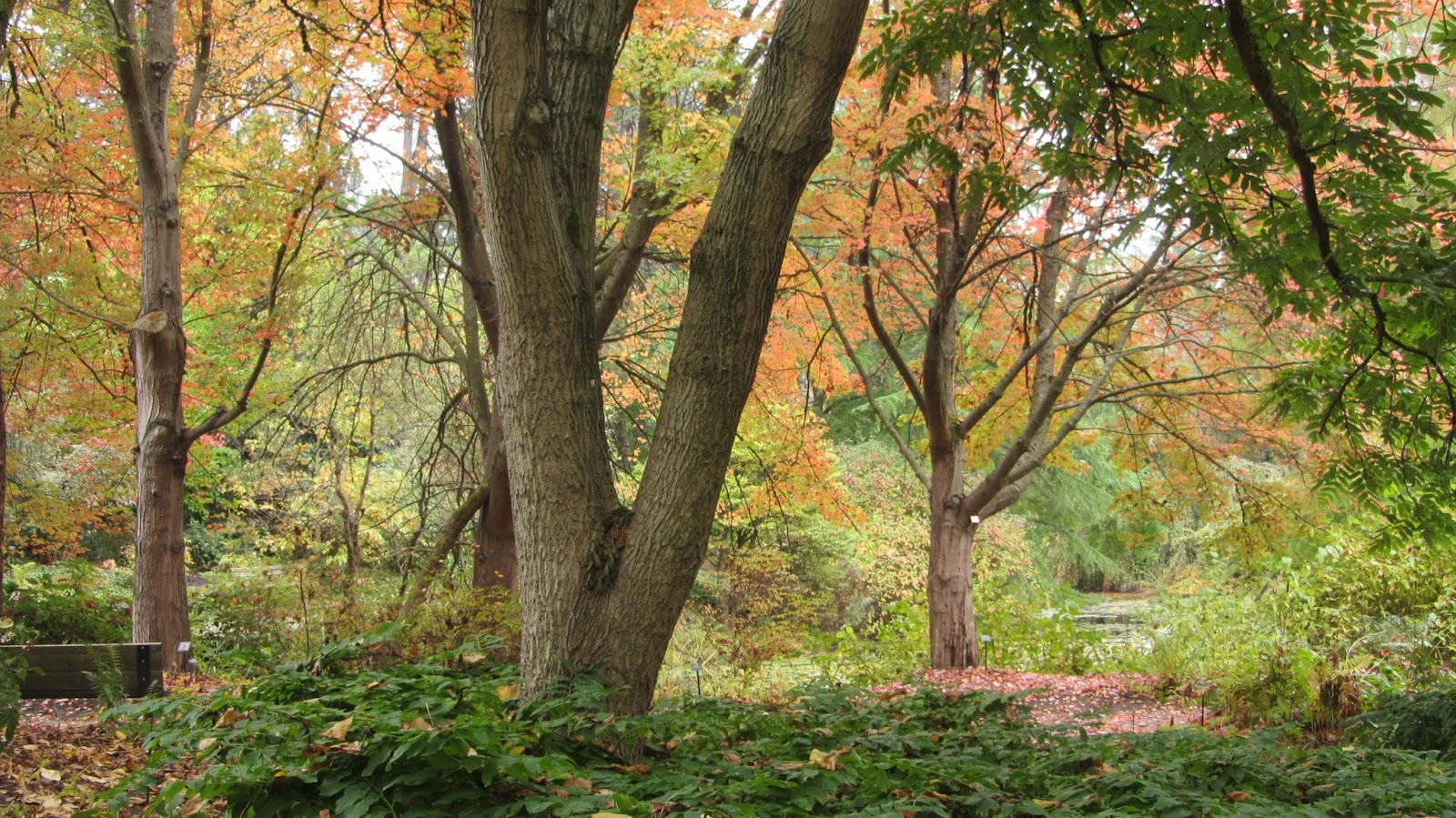
I did, however, manage a poem, inspired by our day-off-date location last week, Van Dusen Gardens, where we went on lots of dates when we lived in Vancouver. It’s a tanka, a Japanese form, 5-7-5-7-7. It’s longer than a haiku, so I like that I can say a bit more.
Fat raindrops splatter,
Crying my unshed teardrops,
Flooding the dry ground.
A brief moment passes, then—
Sun flickers through golden leaves.
I’ve written several tanka lately. I like about tanka and haiku that I can use an image from nature to reflect something I’m thinking about or feeling. Autumn gives lots of possibilities, if I pay attention. The weather and scenery at Van Dusen Gardens suited my state of mind very nicely.


Last week was crazy. I’m still tired. We met lots of friends, hung out at home in our old house with our landlord-family, presented at a couple of missions conferences, and I preached at our Vancouver church home. There were so many wonderful moments of fellowship, mixed up with waves of grief as we remembered the life we left behind there. Our friends’ kids got so big! And everyone sang the hymns at church with such joy… I cried at least twice during the service, thankfully not while I was preaching.

Our friends' kids got so big...
That’s our life: a crazy mixture of joy and grief. The reason the grief hurts so much is because we have loved and been loved so much.

On an entirely different note, one fun surprise from our trip was meeting Mimi, whose husband, Jamie Taylor, was the keynote speaker at several of the events. (Of course, we enjoyed meeting him too.) Mimi is my sempai at Boston University—she studied music there too! It was such an encouragement to talk to her and to hear her sing. Of course I’ve met other missionaries from Regent, but she is the first I’ve met from BU.

Our Vancouver-based colleague, Gary, Mimi and Jamie Taylor, us, and a great big birthday cake for OMF!
I can't resist a couple of food pictures too. We ate really well.

High tea at the Empress Hotel in Victoria. The most recent Empress to have tea there was the Empress of Japan, in case you were wondering.
Pumpkin pie brûlée at The Shaughnessy Restaurant, next to Van Dusen Gardens. Highly recommended.

Tuesday, September 22, 2015

For my introverted friends

It was seven in the morning… and I’d been up all night, because we were having a party, and some of the guests just wouldn’t go home. I stared, bleary-eyed, at the clock, cringing at the thought of my 10 a.m. rehearsal. I knew I would be in no shape for that now. Just as I thought that our guests might finally be starting to think about going home, and that I might get a few hours of precious sleep, the doorbell rang. “Hey, is the party still going?” a voice rang out. I desperately wanted to lock the door and pretend to be asleep, but someone (I’m not naming names) opened the door and let them in. I sighed and pasted a cheery smile on my face, hoping no one would notice how bloodshot my eyes had become.

...And then I woke up. Thank God, it was only a dream. (It’s not like we’re in the habit of hosting all-night parties. I suppose I should have recognized the familiar “something’s not quite right here” feeling that goes along with weird dreams.)

Last week we had a lot of amazing times of food, fun, and fellowship with a whole lot of friends. If you were one of them, thank you! I loved every minute of it. 

But apparently my subconscious was starting to feel strained.

For the record, I’m not trying to say “leave me alone, I’m an introvert.” (Please picture me smiling as I write.) I’m writing this because I think my introverted colleagues and friends will find it funny. So please, dear friends and family, invite me over, come over to my place, or let’s go out for coffee… after I’ve recovered from last week.

Friday, September 11, 2015

Reverse Culture Shock Moments

Today’s coffee: Trader Joe’s

For those of us who have lived overseas, “home” is a complicated subject. I’m back living at my parents’ house, and although in some ways it feels very much like home, in some ways it doesn’t. Having grown accustomed to my life in Japan, leaving our home there and coming back to the US for our “home assignment” of 10 months has been a mixed bag—joy of reunion with friends and family here in the US along with missing people and places we left behind.

Over the course of the last week, I’ve been writing down some of my reverse culture shock moments; like the overall experience of returning to my hometown, they’ve been a mix of joys and sorrows and surprises. Here are some of my experiences and observations.

This little guy (photographed at music camp last month) looks about like how I feel... 
My parents have almost the same Zojirushi (a Japanese brand) hot water pot and rice cooker as we do in Japan. The rice cooker even plays the same song when the rice is done. But the writing on the buttons is in English and the temperature on the hot water pot is in Fahrenheit. I found my eyes were drawn to the “押す” (push) labelled lever to open the water pot and I tried pressing that to get the hot water to come out rather than the English-labelled “dispense” button.

The milk comes in 2 and 4 liters… by which I mean half gallons and gallons. In Japan it comes in liters. But the American “whole milk” isn’t as creamy as the 2.5% we usually buy in Hokkaido.

Making eye contact: I’ve trained myself not to do that, since we often don’t in Japan. Now my lack of eye contact probably makes me look sketchy. (Sorry if I’ve weirded you out.)

Taking tea ceremony classes in Kirkland overlooking Lake Washington is pretty surreal. But outside of my circle of friends, no one knows what tea ceremony is. Or where Hokkaido is. Well, almost no one.

Spending $15 at Starbucks for 2 people: really? (To be fair, we have Starbucks in Japan, but we never went there, since it was far away from where we lived… and if I wanted a chain coffee shop, Doutor was just as good and a lot cheaper… and great sandwiches and cakes.)

Getting a cold: no one has asked me if I’ve been to the hospital yet.

Box springs: why do we even have them? They creak and make the bed too soft. Thankfully my resourceful dad and husband fixed our bed so it doesn’t sag in the middle any more.

No onsen. Sad face.

There is ramen in the Seattle area, but it’s not the same as Hokkaido ramen. (I’ll probably go eat it anyway, because I’m craving it like nothing else.) On the other hand, there’s a much larger selection of ethnic food to be enjoyed (MEXICAN FOOD), although we will miss our neighborhood Indian restaurant in Ishikari.

Free fruit! Cheap fruit! We have already harvested more apples and pears and plums than I could ever hope to eat right out of our yard. Some of them we have preserved in gigantic quart-sized canning jars, which we can’t get in Japan. We will make applesauce this year, and apple pie, which were prohibitively expensive in Japan (1 apple=$1). Also, I bought a melon for less than $3! (Cheap Hokkaido melon=$10)

Keith washes a sink full of apples
Pears and plums
I asked my mom to grow shiso in her garden. I forgot to tell her that shiso plants get quite large. She planted 5 rows.

Our shiso jungle
Seattle rush-hour (or not even rush-hour) is terrifying… especially when I went to make a quick lane change and turned on the wipers instead of the blinker.

We went to eat at Denny’s once and went home knowing more about our waitress’ family than we ever learned about Yasuda-san, who served us breakfast at the Royal Host almost every Monday for two years. Also, compared to booths at family restaurants in Japan, which are quite tall, I was surprised that I could have easily leaned over the back of the booth at Denny’s and started a conversation with the people at the next table. I guess that’s what we did on those late-night large-group Denny’s trips in high school. We ended up speaking Japanese so we could have a private conversation, whereas we spoke English at the Royal Host for the same reason. And the man at the next table over was speaking Chinese on the phone.